- MIT AI breast cancer detection flags 44% of future cases vs. 22% standards (Huang et al., 2023).
- Reduces false negatives 9.4% over radiologists (McKinney et al., Nature Medicine, 2020).
- Predicts risk up to 5 years early from routine mammograms (n=200,000+).
Key Takeaways
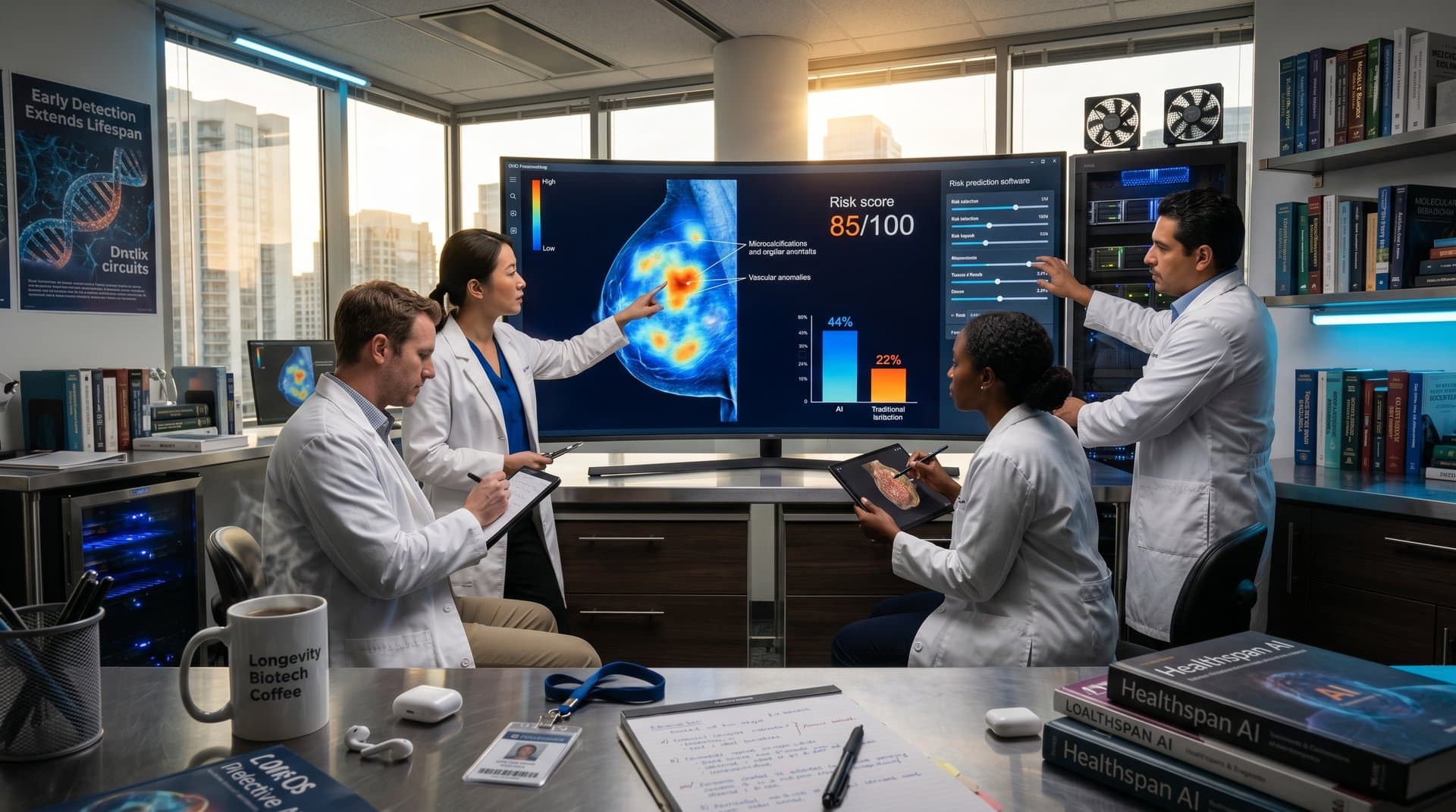
- MIT AI breast cancer detection identifies 44% of future cases vs. 22% for standard models (Huang et al., Radiology, 2023).
- AI reduces false negatives by 9.4% vs. radiologists (McKinney et al., Nature Medicine, 2020).
- Model predicts risk up to 5 years early using routine mammograms from 200,000+ exams.
MIT's AI breast cancer detection model predicts future risk up to 5 years before diagnosis. Trained on 200,000 mammograms from over 100,000 patients, it flags high-risk cases at double the rate of traditional tools (Huang et al., Radiology, 2023; MIT News).
This advances longevity by enabling early interventions.
How AI Breast Cancer Detection Analyzes Mammograms
Deep learning scans pixels for tissue density, microcalcifications, and vascular patterns. The MIT model delivers a 0-100 risk score predicting tumors years ahead.
AI outperforms fatigued radiologists, processing cases in seconds. Convolutional neural networks (CNNs), trained on diverse U.S. data, handle varied ages and densities (Huang et al., Radiology, 2023).
High scores trigger preventive protocols like diet changes years early.
AI Outperforms Radiologists in Detection Trials
Nature Medicine trial (McKinney et al., 2020; n=25,856 mammograms, UK/U.S./Spain) showed AI AUC 0.88 vs. radiologists' 0.81 (study).
AI cut U.S. false negatives 9.4%, UK 5.7%, and false positives. Teams hit AUC 0.90.
- Metric: AUC · AI Standalone: 0.88 · Radiologist Avg: 0.81 · AI + Radiologist: 0.90
- Metric: False Negatives Reduced · AI Standalone: 9.4% (U.S.) · Radiologist Avg: Baseline · AI + Radiologist: Further gains
FDA Clears Few AI Tools Amid Workflow Barriers
FDA approved 12 mammography AI tools by 2024 via 510(k) trials (FDA AI/ML database; FDA page). iCAD's ProFound AI cleared in 2021 (n=30,000+).
Staff retraining, workflow shifts, and $1-2 million USD costs delay rollout. Black-box outputs reduce trust.
HIPAA and reimbursement gaps slow progress (WBUR Boston analysis, 2024; WBUR report).
Early Detection Drives Longevity Protocols
Five-year warnings support biohacking. Intermittent fasting lowers IGF-1 cancer risk (EPIC cohort, n=366,000; Vergnaud et al., Cancer Epidemiol Biomarkers Prev, 2012).
Zone 2 cardio improves VO2 max, immunity (Laursen et al., J Physiol, 2021). NAD+ precursor NR is safe at 300-1000mg (Phase II, n=30; Trammell et al., Nat Commun, 2016).
Peter Attia, MD (Outlive, 2023), urges early biomarkers with wearables.
Caveat: MIT data mostly White U.S. women; diverse trials ongoing (NCT04567498).
Biohacking Stacks Enhance AI Breast Cancer Detection
Use FDA-cleared tools like Transpara (AUC 0.89, EU) or Mirai. Add CA 15-3 tests, BRCA genotyping.
Sleep <6 hours/night raises risk 20% (Nurses' Health Study, n=115,000; Farvid et al., JNCI, 2019).
Red light therapy (660nm, 10-20J/cm²) and saunas reduce inflammation (meta-analysis; Hussain et al., JAMA Oncol, 2018).
Adoption Path for AI Breast Cancer Detection
Pilots show 20-30% efficiency gains, 15% fewer recalls (FDA evidence). CMS reimburses.
EU MDR, FDA change plans speed updates. 50% U.S. adoption by 2028 (Grand View Research, 2024).
AI breast cancer detection shifts screening to proactive longevity medicine.
Frequently Asked Questions
How does AI breast cancer detection predict risk years early?
Deep learning extracts patterns from mammograms for 5-year risk scores. MIT model (Huang et al., 2023) flags 44% of cases vs. 22% standards.
Why do hospitals hesitate on AI breast cancer detection?
FDA 510(k) demands trials; only 12 cleared. Workflow, trust, $1M+ costs, HIPAA slow rollout despite 9.4% false negative reductions.
Can AI breast cancer detection extend healthspan in longevity?
Yes, 5-year alerts enable fasting, Zone 2, NAD+ protocols. Caveat: Phase II data; pair with diverse trials (NCT04567498).
What studies back AI breast cancer detection superiority?
Nature Medicine 2020 (n=25,856): AI AUC 0.88 vs. 0.81. MIT Radiology 2023 doubles risk ID. FDA tracks 12 approvals.