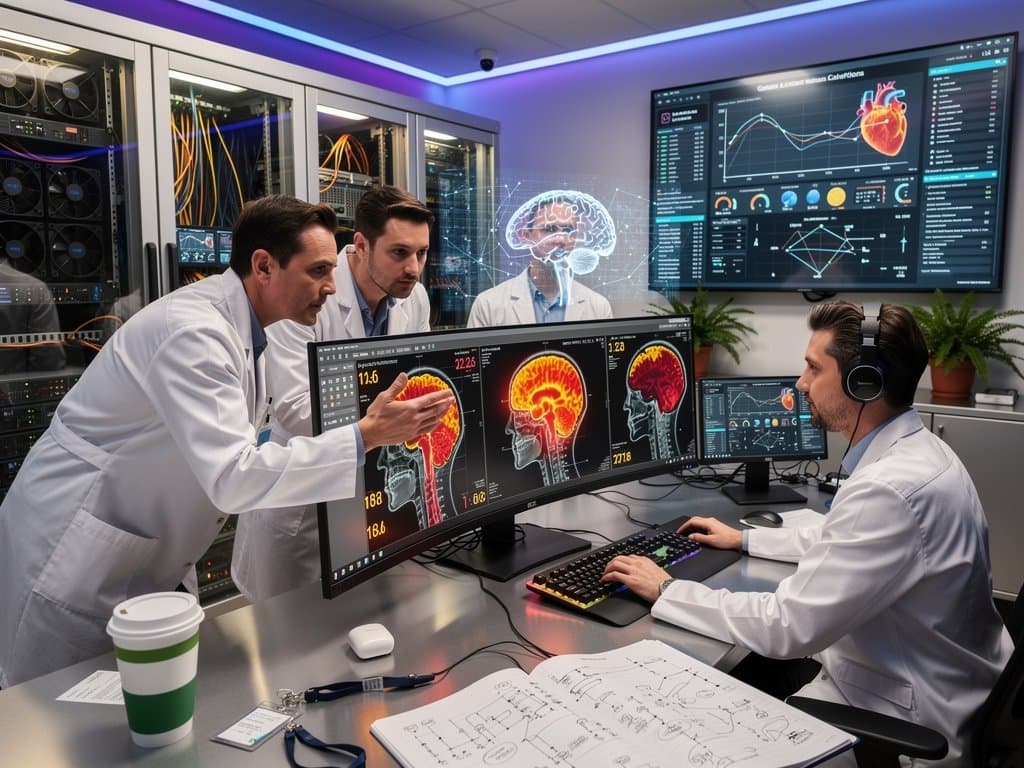
- AI opportunistic screening achieves 0.93 AUC for CAC on head CTs.
- 0.87 correlation to gated CT standards.
- 92% specificity for CAC scores over 100.
Key Takeaways
1. AI opportunistic screening achieves 0.93 AUC for CAC detection on head CTs. 2. Models show 0.87 correlation with gated CT references on 1,000 scans. 3. Specificity hits 92% for CAC scores above 100.
AI opportunistic screening achieves 0.93 AUC for coronary artery calcium (CAC) detection on routine head CT scans. Frontiers in Cardiovascular Medicine researchers (2024) validated this on 1,302 scans (95% CI: 0.917-0.946) after training on 5,302 diverse head CTs from multiple centers.
U.S. hospitals perform 3 million head CTs yearly for stroke, trauma, and headaches. Ungated scans limit cardiac assessment. AI opportunistic screening overcomes this. American Journal of Roentgenology researchers (2023) reported 0.87 Pearson correlation to gated CT expert reads across 1,000 scans.
Cloud inference processes scans in seconds. Radiologists get CAC flags with brain findings. Aidoc and Viz.ai deploy similar AI for chest CTs.
CNNs Power AI Opportunistic Screening on Head CTs
Convolutional neural networks (CNNs) analyze 3D DICOM slices from head CTs. Researchers paired them with gated cardiac CT references for training. Frontiers researchers (2024) generated Agatston scores, the clinical gold standard for CAC.
Skull artifacts and beam hardening challenge detection. Advanced preprocessing corrects issues. CNNs outperform rule-based methods and work across GE, Siemens, and Philips scanners.
Picture archiving systems (PACS) integrate flags for instant review. RSNA Radiology: Artificial Intelligence authors (2024) highlight opportunistic screening for incidental findings.
- Method: Head CT AI · AUC: 0.93 · Gated CT Correlation: 0.87 · Sample Size: 1,302
- Method: Chest CT AI · AUC: 0.95 · Gated CT Correlation: 0.92 · Sample Size: 2,500+
- Method: Cardiac CT · AUC: 0.98 · Gated CT Correlation: 1.00 (reference) · Sample Size: N/A
Data from Frontiers (2024), AJR (2023), RSNA (2024).
Head CT Heart Risk Boosts Longevity Biomarkers
CAC scores predict 10-year cardiovascular risk. Scores above 100 raise odds fourfold, per Multi-Ethnic Study of Atherosclerosis (MESA; n=6,814; 2000-2012). Head CT AI opportunistic screening reveals these during brain exams.
Biohackers use CAC baselines for protocols. They combine scores with Oura Ring HRV or CGM data. Peter Attia, MD, champions CAC scans for healthspan in Outlive (2023).
This adds no radiation or cost. Early flags prompt statins or lifestyle shifts. HOPE-3 RCT researchers (NEJM, 2016; n=12,705) showed rosuvastatin cuts events 24% in moderate-risk patients.
Financial Momentum in AI Diagnostics
CB Insights tracked $500 million USD in VC for AI radiology startups in 2023. Aidoc raised $120 million USD in Series D for multi-organ screening.
FDA cleared chest CT CAC tools like Cleerly and HeartFlow. Head CT tools pursue 510(k) clearance. Annalise.ai pilots full-body screening in Australia and U.S.
Epic Systems embeds AI flags in EMRs. AWS HealthImaging stores CAC trends for longevity tracking.
Open-source models on Hugging Face spur biohacker tweaks. Longevity biotechs license them for protocols.
Precision AI Diagnostics Advance Longevity
Outcomes trials test if CAC flags cut events. RCTs will gauge mortality impacts. Models refine for CAC=0 validation.
Wearable integration builds closed-loop systems. AI opportunistic screening drives prevention. Longevity funds value these at $50-100 million USD pre-revenue.
Frequently Asked Questions
What is AI opportunistic screening?
AI opportunistic screening uses deep learning on routine head CTs to detect CAC. Frontiers (2024) shows 0.93 AUC. It repurposes scans for heart risk.
How accurate is it for heart risk on head CTs?
0.93 AUC detection, 0.87 correlation to gated CT. 92% specificity for high CAC. Holds across scanners.
How does it aid longevity biohacking?
Delivers CAC biomarkers from brain scans. Pairs with wearables for protocols. Enables early interventions.
What tech powers it?
CNNs process DICOM after artifact fixes. PACS flags instantly. Open-source accelerates adoption.