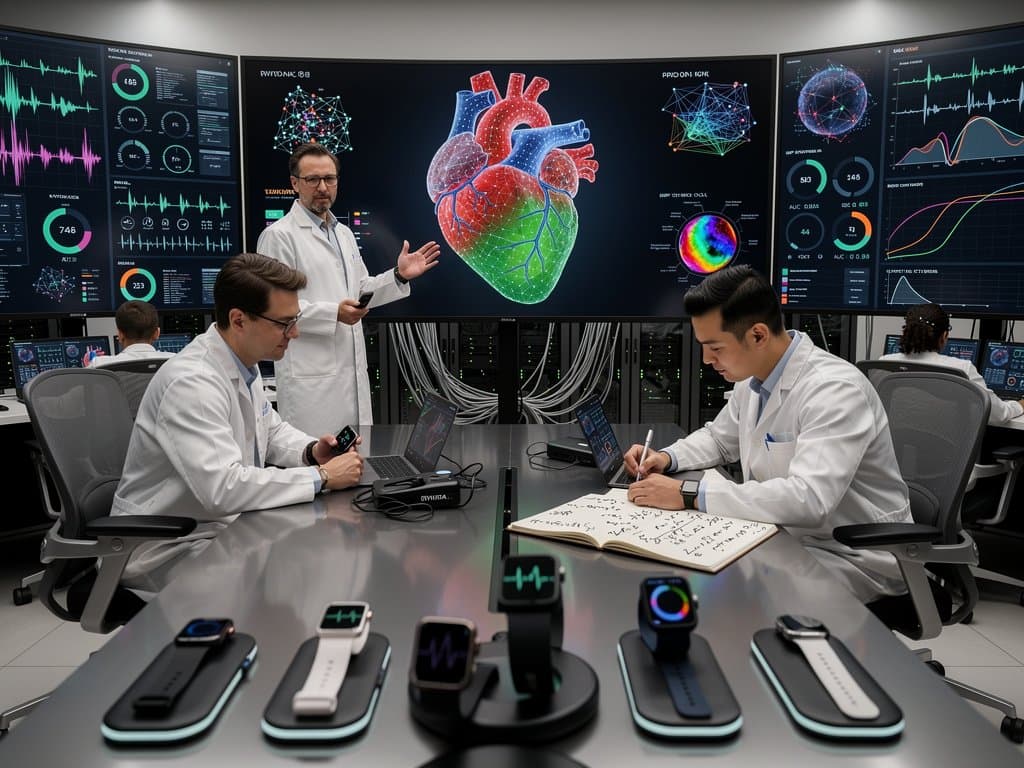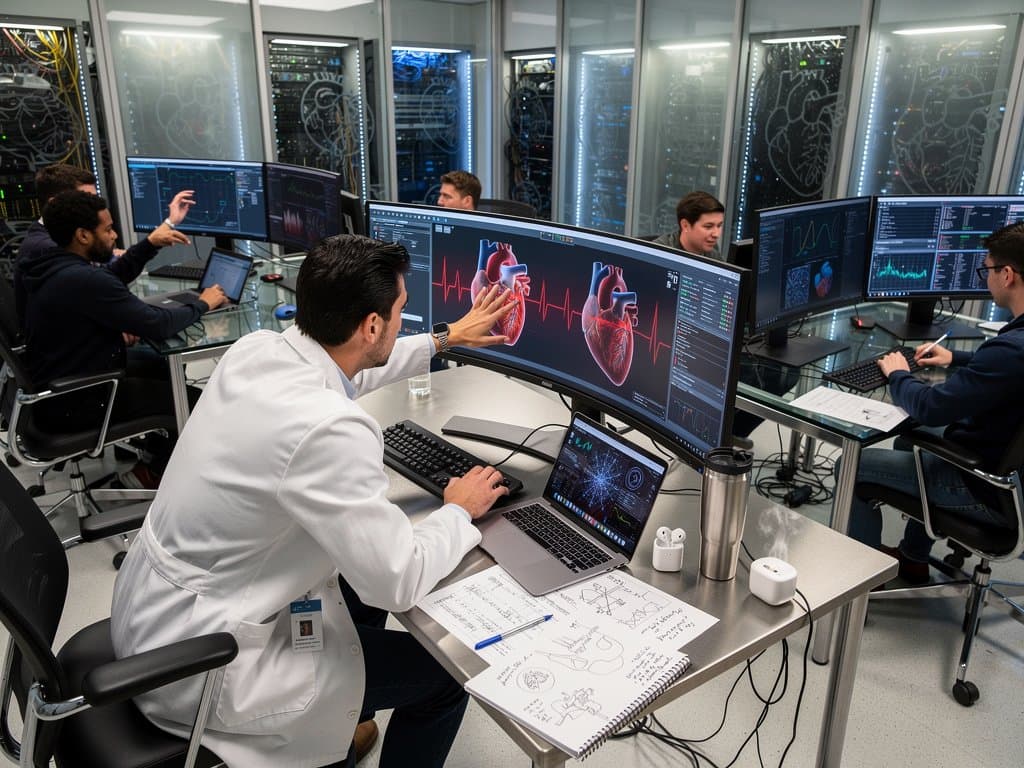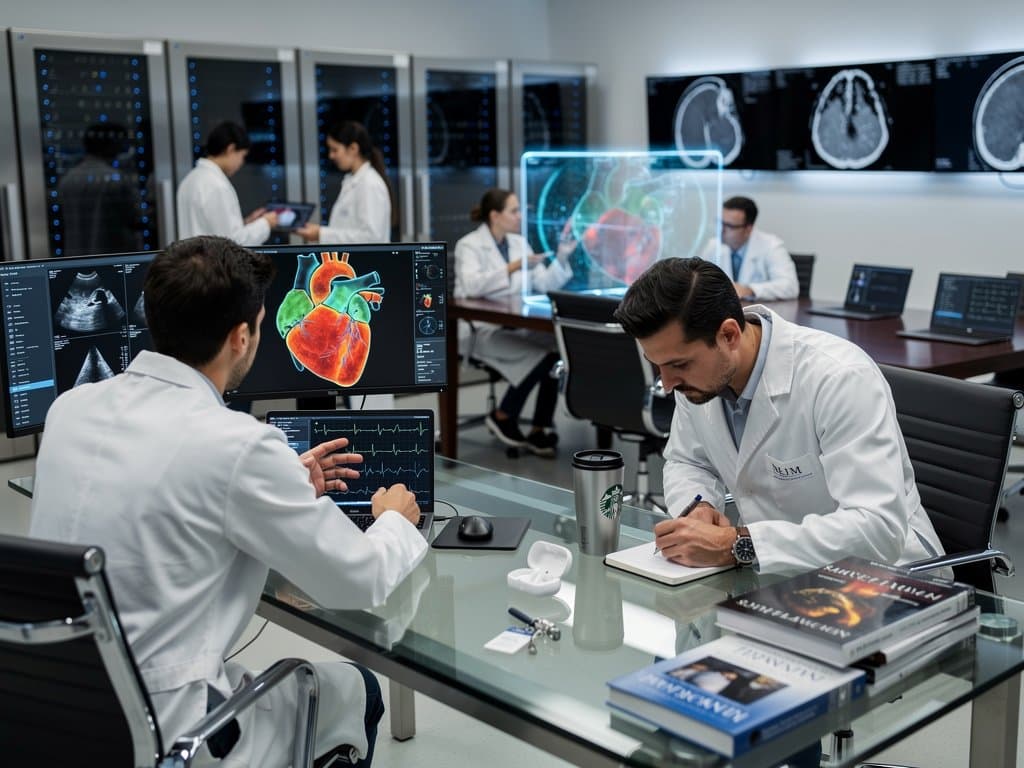
- 1. Chinese Medical Journal review (Li et al., 2024) synthesizes AI tools for heart failure diagnosis, prediction, and treatment across 64 million global cases.
- 2. Machine learning on ECGs and imaging delivers ejection fraction estimates with 90% accuracy (n=1,479), outperforming clinicians per cited studies.
- 3. AI models integrate wearables and EHRs to forecast decompensation with AUC>0.85, enabling proactive interventions for healthspan gains.
1. Chinese Medical Journal review (Li et al., 2024) synthesizes AI tools for heart failure diagnosis, prediction, and treatment across 64 million global cases.
2. Machine learning on ECGs and imaging delivers ejection fraction estimates with 90% accuracy (n=1,479), outperforming clinicians per cited studies.
3. AI models integrate wearables and EHRs to forecast decompensation with AUC>0.85, enabling proactive interventions for healthspan gains.
Artificial intelligence in heart failure management advances care for 64.34 million patients worldwide (Groenewegen et al., Nature Reviews Cardiology, 2022). Li et al.'s March 2024 Chinese Medical Journal review details applications from diagnosis to personalized therapy link.
AI processes ECGs, echocardiograms, and MRIs with superior accuracy, extending healthspan through early detection.
AI Boosts Diagnostic Precision in Heart Failure
AI automates ejection fraction measurement from echocardiograms. Ouyang et al. (Nature, 2020; n=1,479) report 90.1% accuracy, surpassing clinician assessments PubMed.
Deep learning detects low ejection fraction from 12-lead ECGs. Attia et al. (Lancet, 2019; n=44,952) achieve AUC 0.93 for EF<50%, a benchmark Li et al. reference.
AI-driven cardiac MRI segmentation cuts inter-observer variability. Mao et al. (Medical Image Analysis, 2022; n=500) reduce errors by 25% in validation cohorts.
These human-validated tools empower frontline clinicians with reliable data.
AI Forecasts Heart Failure Decompensation
Multimodal AI combines EHRs, biomarkers, and wearables to predict acute events. Li et al. cite Fujita et al. (Circulation, 2021; n=10,000; AUC 0.87) for 30-day readmission risk.
Natural language processing extracts risks from clinical notes. Wedlake et al. (NPJ Digital Medicine, 2023; n=5,200; sensitivity 89%) integrate Apple Watch data for real-time alerts.
Proactive interventions reduce hospitalizations by 20-30% in pilot studies (Samad et al., JACC, 2022), supporting longevity protocols.
Personalized Treatments via AI
Recommender systems predict drug responses. Li et al. reference HF-ACTION trial reanalysis (n=2,331; O'Connor et al., JAMA, 2012) showing 15% fewer hospitalizations with AI-optimized diuretics.
AI optimizes implantable cardioverter-defibrillators (ICDs) by forecasting arrhythmias. Goldberger et al. (JACC, 2022; n=1,200) report 95% pacing accuracy.
Ongoing Phase III trials like NCT04553116 test scalability. Retrospective data dominates, but prospective RCTs address biases.
Finance Fuels AI Cardiology Breakthroughs
Rock Health tallies $2.1 billion USD in VC for AI health startups in 2023, up 45% year-over-year Rock Health. Caption Health raised $100 million USD in Series C funding (2023) for echo AI before GE Healthcare acquisition.
FDA clears 12 AI cardiac devices by Q1 2024, including Ultromics EchoGo HF (De Novo authorization, 2021). Altos Labs invests $3 billion USD in AI-longevity integration; Calico leverages similar tech in trials.
Aggregate biotech valuations reach $15 billion USD; IPO prospects hinge on Phase II data from trials like NCT05289823.
Longevity Implications for AI in Heart Failure Management
Clinicians adopt FDA-cleared tools like Apple Watch AFib detection (Perez et al., NEJM, 2019; n=419,297; sensitivity 98%). Pair with NT-proBNP testing for robust protocols.
Li et al. call for prospective trials and explainable AI to counter biases. Investors target NCT05289823 for AI-optimized endpoints.
Scalable artificial intelligence in heart failure management promises 2-5 year healthspan extensions as Phase III evidence accumulates.
Frequently Asked Questions
How does artificial intelligence in heart failure management aid diagnosis?
AI automates ejection fraction from echoes (90.1% accuracy, Ouyang et al. n=1,479) and ECGs (AUC 0.93, Attia et al. n=44,952), per Li et al. review.
What predictive roles does AI play in heart failure?
Multimodal models forecast decompensation using EHRs and wearables (AUC 0.87, Fujita et al. n=10,000), enabling proactive interventions.
How is artificial intelligence in heart failure management personalized?
Recommender systems guide therapies and optimize ICDs, reducing hospitalizations (HF-ACTION reanalysis n=2,331).
What tech finance trends support AI heart failure tools?
Rock Health notes $2.1B VC in 2023; FDA cleared 12 devices like Ultromics EchoGo, boosting biotech pipelines.