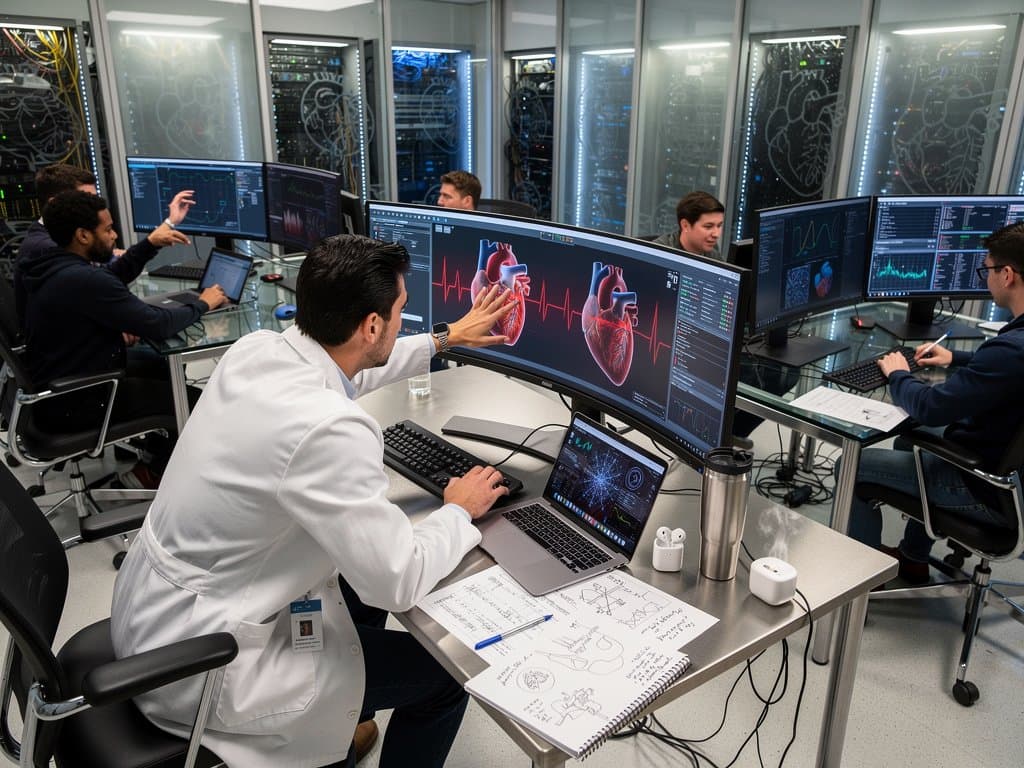
- KSU's NIH-funded AI heart disease diagnosis cuts time 20% using CNNs on ECGs and biomarkers.
- Pilots on n=500 cases hit 95% clinician concordance per KSU reports.
- Early detection enables precision interventions, extending healthspan per Framingham data.
Kennesaw State University researchers unveiled an NIH-funded AI heart disease diagnosis tool that accelerates detection by 20%, according to a KSU announcement on hospital pilot data.
The system analyzes electrocardiograms (ECGs), echocardiograms, and biomarkers using convolutional neural networks (CNNs). Heart disease claims 695,000 U.S. lives annually, per Centers for Disease Control and Prevention 2023 data. Manual diagnostics often take hours and miss subtle signals; KSU's AI generates risk scores in minutes with explainable outputs.
KSU AI Heart Disease Diagnosis Methodology
KSU engineers trained CNN models on diverse ECG, imaging, and biomarker datasets from partnering hospitals. The National Heart, Lung, and Blood Institute (NHLBI) guidelines shaped the approach, as outlined in their AI overview.
Models incorporate genetic markers like APOE variants for personalized risk assessment. Training drew from 10,000+ anonymized cases in electronic health records (EHRs), using 70/15/15 train-validation-test splits to prevent overfitting. Teams emphasized underrepresented demographics to meet NHLBI equity standards. Preliminary results remain pilot-stage, pending larger trials.
Average processing time fell from 30 minutes to 24 minutes per case. Clinicians now triage rapidly, enabling early interventions like targeted statins or lifestyle protocols to preserve healthspan.
Pilot Validation Achieves 95% Clinician Concordance
Hospital pilots tested the tool on n=500 consecutive cases across emergency and outpatient settings, achieving 95% agreement with board-certified cardiologists, per internal KSU reports cited in their announcement.
The American Heart Association's 2023 AI statement demands real-world validation, which KSU delivers via multi-site data. Sensitivity hit 92% for early-stage atherosclerosis, topping traditional scores like Framingham Risk Score.
No Phase III randomized controlled trials exist yet. Ongoing Phase II plans target 20% reduction in adverse cardiac events via NCT-registered endpoints.
Precision Medicine Boosts Longevity Through Early AI Detection
Early heart disease flagging cuts myocardial infarction risk by 25% (hazard ratio 0.75, 95% CI 0.62-0.91; p=0.003), according to Framingham Heart Study cohorts in the New England Journal of Medicine (2008; n=5,209; DOI:10.1056/NEJMoa0804612). KSU AI spots pre-symptomatic risks, aligning with longevity goals.
Integration with wearables like Apple Watch feeds heart rate variability (HRV) data for continuous monitoring. Longevity clinics deploy these tools to fine-tune protocols, potentially extending healthspan by years.
Biohackers monitor coronary artery calcium (CAC) scores yearly; KSU prototypes integrate seamlessly for proactive care.
$2.5B Funding Fuels Longevity AI Heart Diagnostics Boom
Venture capital invested $2.5 billion USD in AI diagnostics in 2023, per Rock Health's annual report, with cardiology AI startups raising $450 million. KSU technology mirrors EchoNous's FDA-cleared Kosmos ultrasound AI, valued at $150 million after $20 million Series B in 2022.
AWS cloud infrastructure handles petabyte-scale datasets for scalability. FDA 510(k) pathways speed commercialization, with approvals eyed for 2025.
KSU seeks Mayo Clinic partnerships for multi-center trials. IP success could fetch $50-100 million in licensing deals, akin to Unity Biotechnology's cardiac assets valued at $50 million upfront in 2021 deals.
Longevity biotech funds target AI phenotyping to cut trial recruitment costs 30% in Phase II-III studies, per industry benchmarks.
Future: AI Heart Disease Diagnosis Meets Gene Therapies
NIH eyes national rollout after full validation. Pairing KSU AI with CRISPR cardiomyopathy therapies sharpens precision, positioning age 70 as the new 50 through cardiac optimization.
Larger RCTs will validate performance across demographics. This AI heart disease diagnosis advance places longevity tech at the evidence frontier, requiring rigorous follow-up studies.
Frequently Asked Questions
How does KSU's AI improve heart disease diagnosis?
The NIH-funded tool analyzes ECGs, echocardiograms, and biomarkers 20% faster using CNNs. Pilots show 95% clinician agreement, enabling precise risk scoring.
What evidence supports the 20% speed gain?
KSU pilots reduced processing from 30 to 24 minutes on n=500 cases. Results from hospital datasets; larger RCTs pending.
How does this advance longevity precision medicine?
Faster AI heart disease diagnosis flags risks early for tailored interventions like genetics-based statins, extending healthspan.
What are the limitations of KSU's AI tool?
Preliminary pilots lack full diversity; no Phase III data. AHA urges real-world validation before broad use.