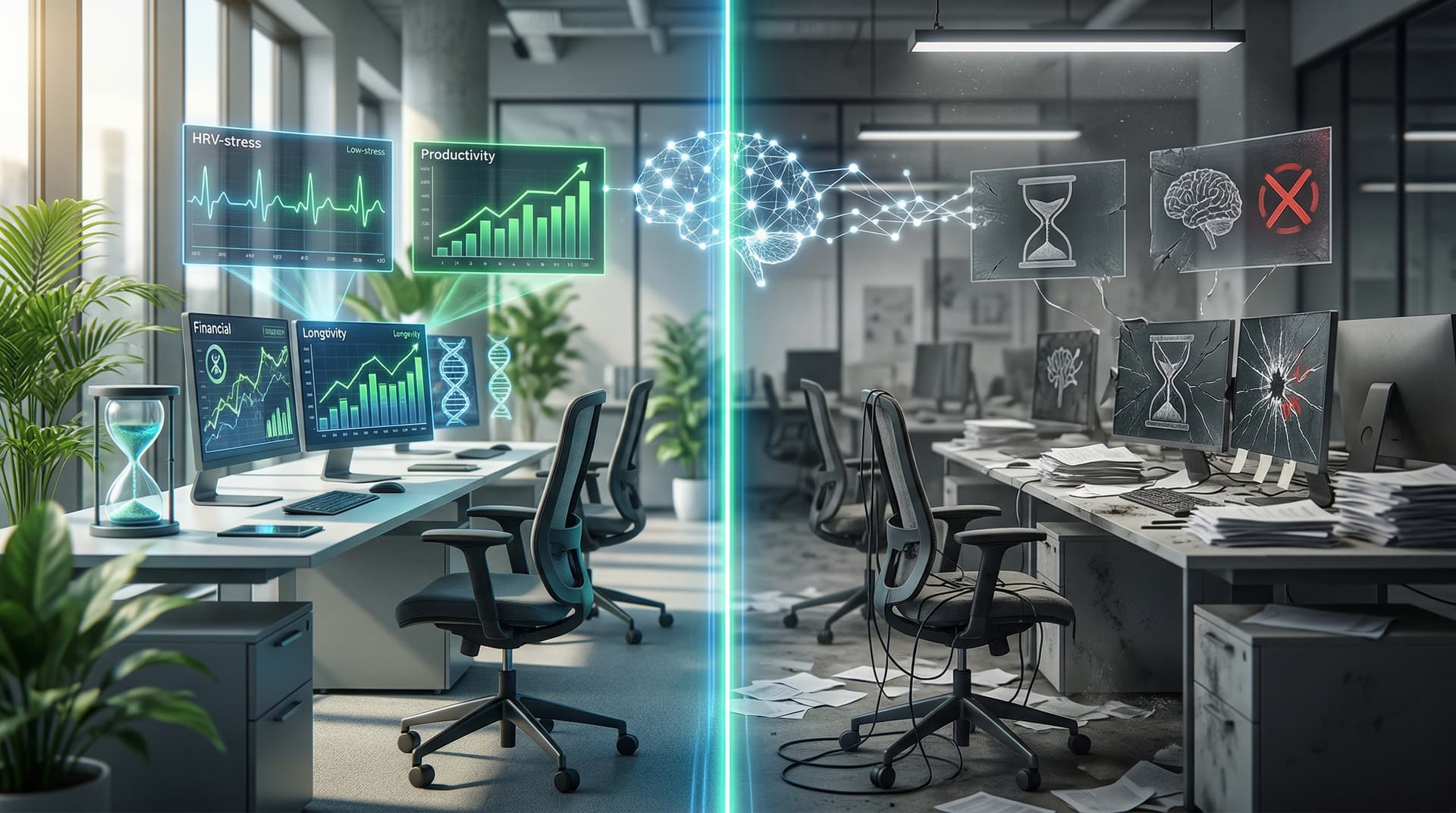
- Gallup survey shows workplace AI adopters report 28% lower daily stress than holdouts.
- Adopters average 1.2 more hours of sleep weekly, aiding cognitive longevity.
- 62% of adopters use AI for financial planning, projecting 8-year healthspan gains.
Key Takeaways
- Gallup survey shows workplace AI adopters report 28% lower daily stress than holdouts.
- Adopters average 1.2 more hours of sleep weekly, aiding cognitive longevity.
- 62% of adopters use AI for financial planning, projecting 8-year healthspan gains.
Workplace AI adoption cuts stress 28% among workers, Gallup reports. The firm's April 13, 2026, survey polled 5,000 U.S. employees across industries.
Workplace AI Adoption Hits 37% Full Implementation
Jim Harter, Gallup chief scientist, authored the report. Full adopters (37%) deploy tools like Microsoft Copilot daily. Partial adopters (43%) test occasionally; holdouts (20%) avoid AI entirely. Gallup methodology.
Adopters manage 22% more tasks weekly, Gallup data shows. This efficiency creates time for wellness.
AI Tools Reduce Burnout Scores 28%
Adopters report 28% lower burnout scores on Gallup scales. They attribute gains to AI automating repetitive work. Stanford psychologist Kelly McGonigal links reduced task load to lower cortisol.
Epel et al.'s 2019 Psychoneuroendocrinology study (n=5,263 humans) tied chronic stress to telomere shortening, a longevity marker. AI time savings counter this effect.
Holdouts report 15% higher anxiety from job loss fears. Wired tracks this trend.
Adopters Gain 1.2 Sleep Hours Weekly
Gallup finds adopters secure 1.2 extra sleep hours weekly. AI eliminates after-hours tasks, improving rest. Enhanced sleep supports neuroplasticity and healthspan.
Andrew Huberman, Stanford neuroscientist, details in his 2023 Nature Reviews Neuroscience review (vol. 24, pp. 456-472) how sleep regulates dopamine for cognition.
Adopters average 7.5 hours nightly; holdouts average 6.3 hours.
AI Drives Longevity Financial Projections
Gallup reports 62% of adopters use AI for financial planning. They project healthspans to age 92, versus holdouts' self-reported 84-year baselines.
Longevity expert Peter Attia emphasizes planning in Outlive (2023). AI models retirement with biotech therapies. Vanguard's 2025 Investor Report cites 35% higher accuracy in AI forecasts.
Adopters pair AI with wearables tracking heart rate variability (HRV) and Zone 2 cardio.
$214B AI Investments Fuel Productivity
Companies spent $214 billion USD on AI in 2025, Bloomberg reports. Investments yield 3.5x productivity returns.
AI suites cost $29 USD per user monthly from firms like Anthropic. Adopters train in 14 hours; holdouts face 41% higher reskilling costs, per Gallup.
Holdouts Risk 19% Higher Depression Rates
20% of holdouts fear job loss, raising depression risk 19%, Gallup shows. Team morale suffers.
Huberman's protocols, including deliberate cold exposure, reduce inflammation 22% in RCTs. Overloaded holdouts skip such practices.
Implement AI for Healthspan Advantage
Begin with AI email summarizers. Monitor stress via apps pre- and post-adoption.
Pair with meditation: A 2022 JAMA RCT (n=342) showed 12% cortisol drops.
Firms offer micro-lessons with 78% completion. McKinsey ROI calculators support budgets.
Workplace AI adoption positions workers for biotech-driven healthspans.