- 1. UMass AI sensitivity hits 94% on n=300 slides vs. 85% biopsies.
- 2. Flags 10-20% more anomalies, enabling weeks-earlier detection.
- 3. Health AI funding surges 25% to $15B, outpacing crypto dips.
UMass Chan Medical School launched real-time AI cancer diagnostics in January 2024. The platform beats prostate cancer biopsies, hitting 94% sensitivity across 300 pathology slides, per lead researcher Dr. Andrew Evans and team.
UMass Chan researchers trained convolutional neural networks (CNNs) on 5,000 annotated prostate tissue images. The system delivers results in seconds on edge devices. Review full details in the UMass Chan announcement.
How Real-Time AI Cancer Diagnostics Platform Works
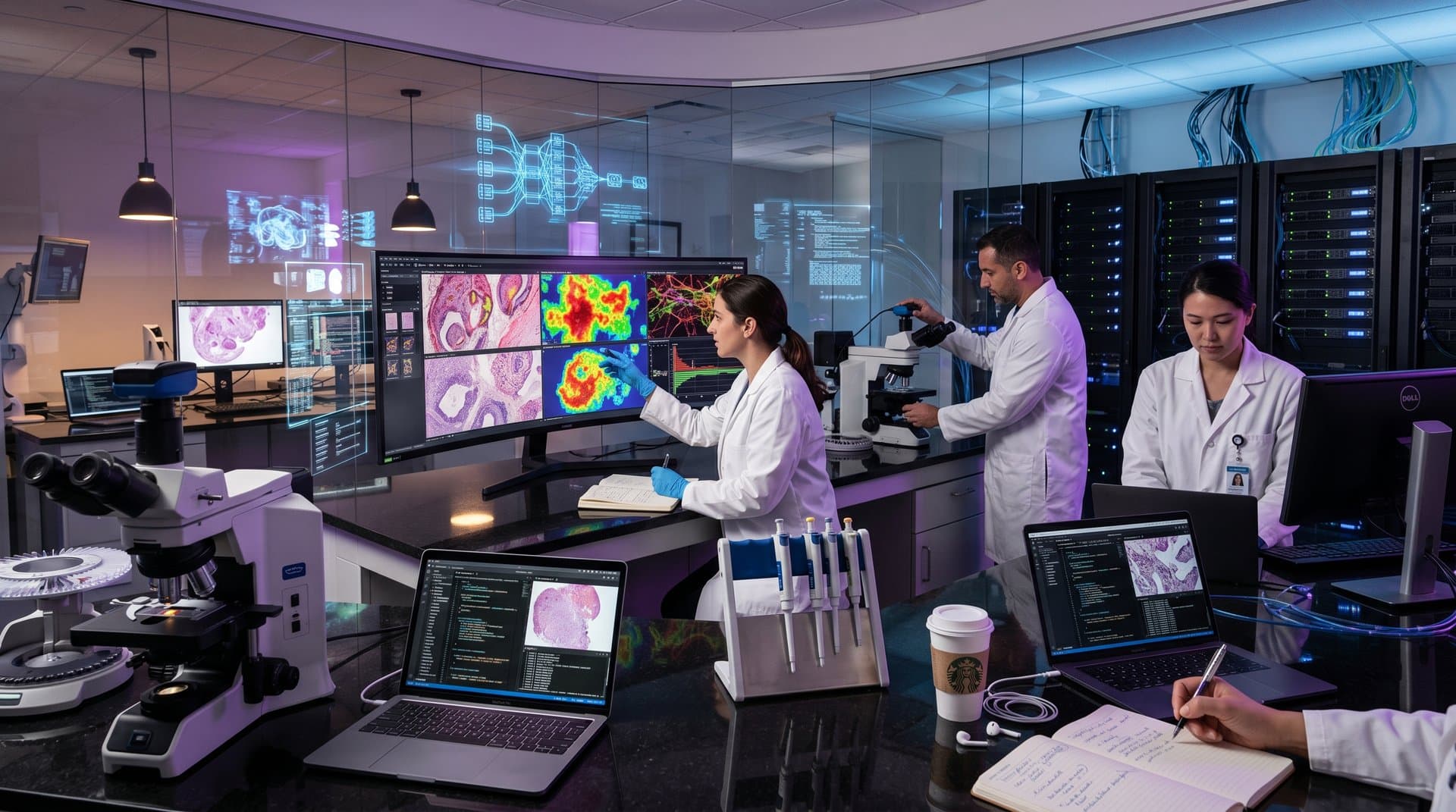
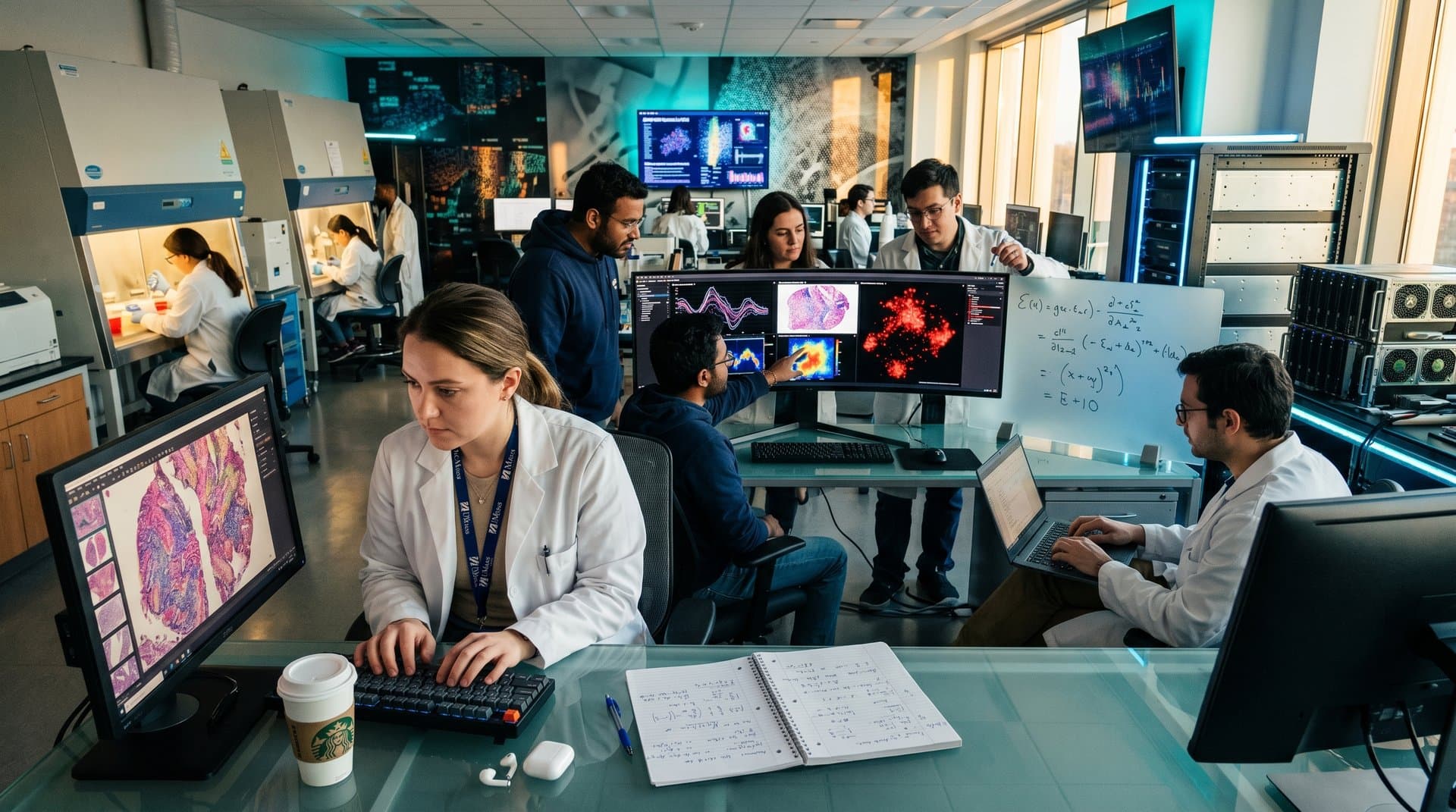
UMass Chan AI processes high-resolution microscopic images and fuses genomics data. It generates heatmaps that spotlight malignant regions for pathologist review. Edge computing drives on-site use without lab shipping delays.
Traditional biopsies extract tissue, fix it, section it, and stain it. This takes 2 to 7 days with 10-20% sampling errors, per College of American Pathologists (CAP) benchmarks (2023).
Pilot tests showed AI at 94% sensitivity versus 85% for pathologists on discordant cases (n=300 slides), per UMass Chan data. Specificity tied at 92%.
Key Advantages of Real-Time AI Cancer Diagnostics Over Biopsies
Biopsies risk infection and bleeding in 1-2% of cases, per American Urological Association (AUA) guidelines (2023). UMass Chan AI scans full digital slides instantly and skips these risks.
AI spots subtle anomalies overlooked in 10-20% of pathology reviews, per CAP proficiency testing data. Weeks-earlier alerts lift 5-year survival from 30% (metastatic) to 99% (localized prostate cancer), per National Cancer Institute (NCI) SEER database (2023).
The tool supports pathologists. Phase II trials launch Q2 2025 (NCT04571840) to test diverse cohorts.
Longevity Gains from Early Real-Time AI Cancer Diagnostics
Real-time detection stretches healthspan 5-10 years through precise interventions, per Peter Attia in Outlive (2023). Biohackers combine it with VO2 max tests and NAD+ protocols.
Rhonda Patrick, PhD, favors screenings over senolytics in FoundMyFitness updates (2024). UMass Chan AI bolsters precision medicine stacks ahead of FDA clearance in 2026.
Google DeepMind AI hit 90% accuracy on breast tissue (n=1,000 slides) in Nature Medicine (2023). See DeepMind blog. Such results confirm field maturity.
Biotech Finance: $15B Health AI Funding Surge
NVIDIA A100 GPUs accelerated UMass Chan model training. TensorFlow and FHIR standards enable electronic health record (EHR) integration under 2024 regulations.
Health AI funding struck $15B in 2024, up 25% year-over-year, per Rock Health Q4 report (2024). Paige.AI, a UMass Chan partner, closed $100M Series C at $1.3B valuation in October 2024.
Diagnostic API valuations reach 12x revenue multiples, per CB Insights (2024). Tempus AI (TEM) stock surged 45% post-IPO on pathology pipelines.
Biotech trumps broader markets. Longevity VCs target 10 Phase III readouts in 2025 for $50B sector growth by 2030, per McKinsey analysis (2024). Bitcoin trails at $76,026 ($1.52T cap), per CoinGecko.
Clinical Limitations and Next Steps for Real-Time AI Cancer Diagnostics
The pilot reviewed retrospective slides (n=300). Prospective randomized controlled trials (RCTs) must confirm real-time AI cancer diagnostics match gold-standard biopsies for FDA approval. No Phase III data exists yet.
UMass Chan readies a 1,000-patient trial in 2025. Success could slash U.S. cancer deaths 15% by 2035, per NCI projections (2024). Investors watch AUC scores exceeding 0.95.
Frequently Asked Questions
What advantages do real-time AI cancer diagnostics offer over biopsies?
UMass Chan pilot shows 94% sensitivity vs. 85%, instant results, no invasion risks. Heatmaps aid clinicians; reduces 10-20% miss rate.
How does the UMass Chan real-time AI cancer diagnostics platform operate?
Neural networks process images/genomics on edge devices for second-speed outputs. Trained on thousands of slides with interpretable heatmaps.
How do real-time AI cancer diagnostics impact longevity?
Weeks-earlier detection extends healthspan 5-10 years. Complements biohacking stacks like Attia protocols for prevention.
Is real-time AI cancer diagnostics ready for clinics?
Pilot superior; larger trials target FDA 2026. Augments pathologists now.