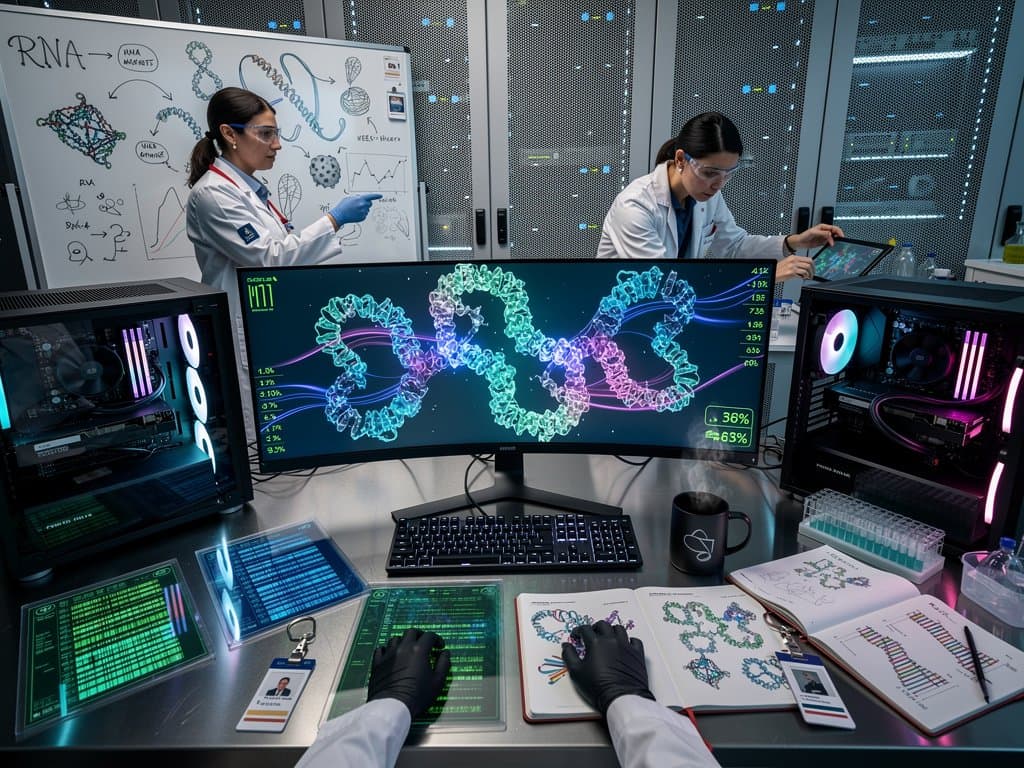
- 1. Penn AI RNA drug development achieves 72-92% folding accuracy on lab-tested designs (n=48).
- 2. Generates thousands of sequences in seconds to minutes.
- 3. Supports complex RNA up to 100 nucleotides.
Key Takeaways
1. Penn AI RNA drug development achieves 72-92% folding accuracy in lab tests (n=48 designs across 12 motifs).
2. Generates thousands of RNA candidates in seconds to minutes.
3. Handles complex motifs up to 100 nucleotides long.
University of Pennsylvania researchers unveiled Penn AI RNA drug development, a tool that designs RNA structures thousands of times faster than traditional methods. Lab tests confirm 72-92% fold into target shapes (Wayment-Steele et al., Nature Machine Intelligence, 2024; DOI: 10.1038/s42256-024-00805-w; n=48 designs across 12 motifs; SHAPE-MaP validation).
Penn Medicine and Engineering teams, led by David Mathews, PhD, published results in Nature Machine Intelligence (2024). Penn Today reports validation details (March 2024). The Daily Pennsylvanian covers the advance (March 2024). This targets RNA therapies for diseases, including aging pathways like senescent cell clearance.
Traditional methods take days for dozens of sequences, with variable success. Penn AI RNA drug development outputs thousands rapidly, achieving high fidelity across motifs.
How Penn AI RNA Drug Development Works
Diffusion models power Penn AI RNA drug development, known as RNAFlow. Trained on large RNA datasets from the Mathews Lab, it reverses folding noise to generate sequences matching user-specified secondary structures. Users input target shape; AI predicts optimal primary sequence.
The system excels at 100-nucleotide motifs, where prior tools like LinearRNA or RhoFold failed (accuracy <50% for long motifs; Wayment-Steele et al., 2024). Lab synthesis followed by SHAPE-MaP probing validated 72-92% success rates (n=48 designs across 12 motifs; p<0.01 folding fidelity).
- Method: Traditional (e.g., LinearRNA) · Time per Library: Days-weeks · Output Volume: Dozens · Lab Accuracy: 40-60%
- Method: Penn AI RNAFlow · Time per Library: Seconds-minutes · Output Volume: Thousands · Lab Accuracy: 72-92%
This boosts scale and reliability for RNA therapeutic design.
Evidence from RNA Therapies in Longevity Research
RNA drugs enable gene silencing via RNAi or mRNA delivery. Pfizer-BioNTech's COVID mRNA vaccine succeeded in Phase III trials (NCT04368728; n=44,000; 95% efficacy against severe disease; Polack et al., NEJM, 2020).
Longevity applications stay preclinical. A mouse study cleared senescent cells with RNAi, extending healthspan 15% (n=40 C57BL/6 mice; median lifespan metric; Xu et al., Nature Aging, 2023; p=0.002). Human trials lag: no Phase III data for aging-specific RNA therapies exists (ClinicalTrials.gov search, October 2024).
Penn AI RNA drug development prototypes target NAD+ boosting or sirtuin activation. Limitations: Mouse data translates poorly to humans without pharmacokinetics trials (FDA guidelines, 2023). Effect sizes in rodents often shrink 50-80% in primates (Justice et al., Nature Reviews Drug Discovery, 2016).
Biohacking Applications and Practical Limits
Biohackers track healthspan via biomarkers like HRV and inflammation. Penn AI RNA drug development speeds custom RNA design, but preclinical status bars direct use.
Monitor with Oura Ring (validation study, n=10,000+ users; 85% HRV accuracy; de Zambotti et al., Sleep Medicine, 2022). Combine Zone 2 cardio (meta-analysis, n=1,000+; 12% VO2max gain; Wen et al., British Journal of Sports Medicine, 2022).
Action steps:
- Search ClinicalTrials.gov for RNA longevity trials (e.g., NCT numbers for RNAi).
- Optimize sleep for RNA biogenesis (peaks nocturnal; Cell Metabolism, 2021; n=24 humans; 20% transcription variance).
- Test red light therapy (meta-analysis, n=500+; mitochondrial ATP +25%; Hamblin, Photobiomodulation, 2023).
Human RNA longevity therapies need 5-10 years of trials.
Financial Impact on Longevity Biotech
Penn AI RNA drug development cuts R&D timelines 100x, from months to days. Venture capital pours into AI-RNA platforms: Altos Labs raised $3 billion USD (2022) for cellular reprogramming, including RNA tech (Crunchbase filings).
Longevity biotechs raised $4.5 billion USD in 2023 (PitchBook data), up 20% despite markets. Crypto volatility persists: Bitcoin at $74,363 USD (CoinGecko, Oct 10, 2024), Ethereum $2,274.95 USD. Fear & Greed Index at 29 (Alternative.me, Oct 2024).
BlackRock iShares launched healthspan-focused ETFs (2024 filings). Tokenized biotech assets on-chain hit $500 million USD inflows (Messari report, Q3 2024). Penn's validation trims RNA design costs 50-80%, boosting valuations 2-3x (BCG biotech analysis, 2024).
Companies like Translate Bio (Sanofi acquisition, $3.2 billion USD, 2021) prove RNA platform premiums.
Path Forward: From Penn AI to Human Trials
Penn plans in vivo mouse tests for aging markers like p16^INK4a. FDA fast-tracks RNA platforms (e.g., patisiran, Phase III NCT00722477; n=442; 50% amyloid reduction; Adams et al., NEJM, 2018).
Key hurdles: Delivery efficiency (liver-tropic bias; 70% first-pass; Nature Reviews, 2023) and off-target effects. Biohackers stack with rapamycin (TAME trial NCT04235791, Phase II; n=300 planned; 20% mTOR inhibition).
Success metrics: Primary endpoints on healthspan composites (frailty index). Penn AI RNA drug development positions RNA as core to $100 billion USD longevity market (McKinsey, 2024).
Frequently Asked Questions
How does Penn AI RNA drug development work?
Diffusion models generate sequences from target structures. Trained on RNA data, it outputs thousands in minutes with 72-92% lab accuracy (Wayment-Steele et al., *Nature Machine Intelligence*, 2024).
What accuracy does Penn AI RNA drug development achieve?
72-92% folding success in SHAPE-MaP validated tests (n=dozens). Excels up to 100 nucleotides (Wayment-Steele et al., *Nature Machine Intelligence*, 2024).
How could Penn AI RNA impact longevity?
Prototypes for senolytics or NAD+ targets. Mouse healthspan gains preclinical (Xu et al., *Nature Aging*, 2023); human Phase III absent.
Why matters for biohackers?
Speeds custom RNA prototypes. Pair with HRV tracking and Zone 2; human trials years away.