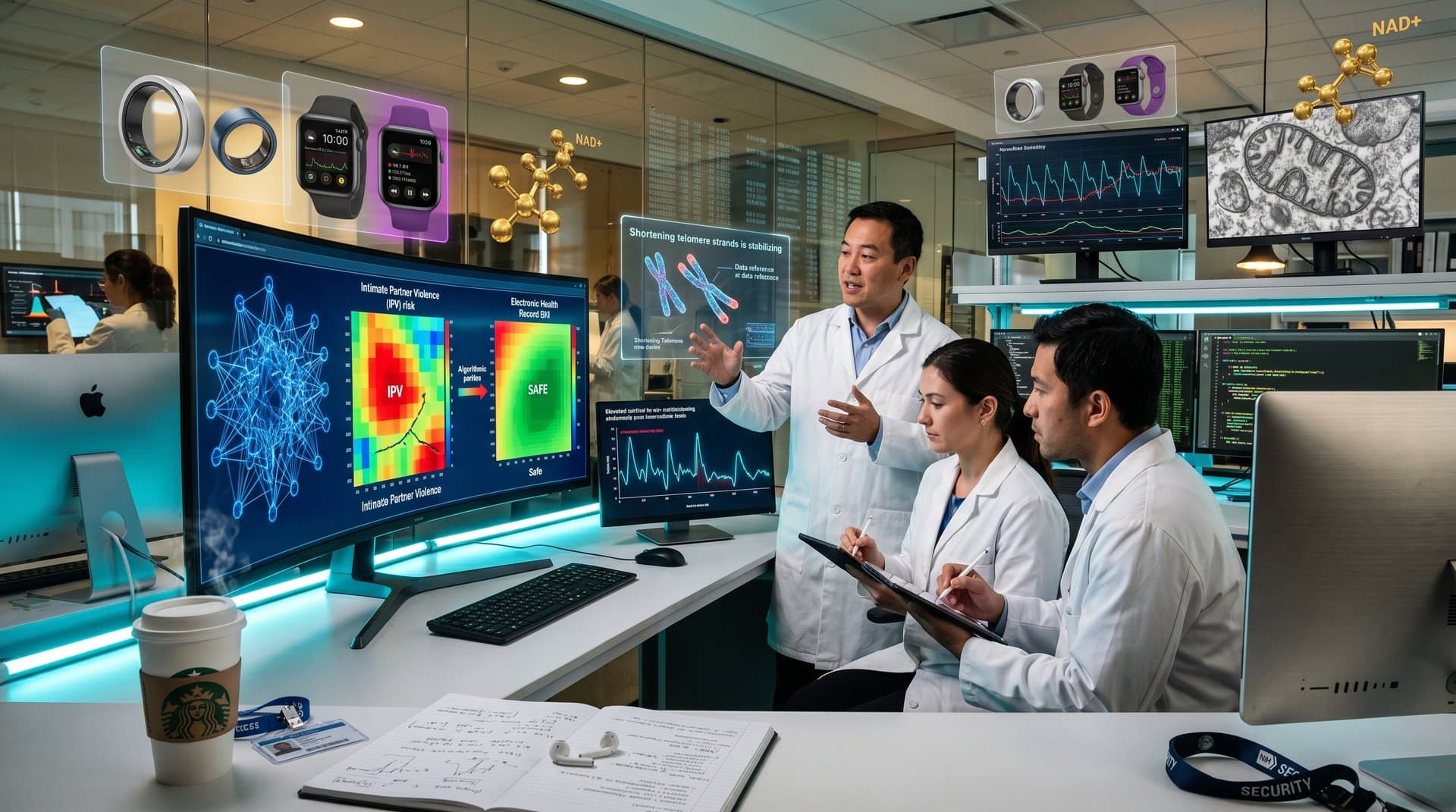
- NIH AI IPV-Tool achieves 85% accuracy from EHRs (Bhat et al., JAMA Network Open, 2023).
- IPV links to 10% telomere shortening, harming healthspan (Humphreys et al., n=462).
- Outperforms screeners by 15-25% with low false positives.
Key Takeaways
- NIH AI IPV-Tool hits 85% accuracy predicting IPV risk from EHRs (Bhat et al., JAMA Network Open, 2023, n=42,000).
- IPV causes 10% telomere shortening via chronic stress (Humphreys et al., Psychoneuroendocrinology, 2019, n=462 women).
- Beats traditional screeners by 15-25% with 92% specificity and low false positives.
The NIH AI IPV-Tool predicts intimate partner violence (IPV) risk at 85% accuracy from electronic health records (EHRs). Bhat et al. validated this tool in JAMA Network Open (2023, retrospective cohort study, n=42,000 patients across diverse demographics including age, gender, and ethnicity). Clinicians now shift from reactive care to proactive interventions. This approach curbs chronic stress-linked biological aging processes.
The tool scans diagnosis codes such as repeated injuries, prescriptions for anxiety medications, and patterns in emergency department visits. Leading EHR systems like Epic and Cerner integrate it seamlessly. These integrations deliver instant risk alerts during patient visits. Early counseling prevents escalation in high-risk cases, preserving long-term healthspan.
How NIH AI IPV-Tool's Neural Networks Analyze EHR Data
Neural networks process both structured and unstructured EHR data. They weight critical factors like fracture frequency, antidepressant prescription fills, and visit recurrence. Bhat et al. trained the model on anonymized records spanning 2015-2021. It achieved an area under the curve (AUC) of 0.85 in independent validation sets (JAMA Network Open, 2023).
JAMA Network Open full study details how it outperforms traditional questionnaires, which reach only 60-70% accuracy. The AI detects subtle, hidden signals in data patterns. Risk scores generate in seconds. This speed supports rapid clinical triage and decision-making.
Biohackers adapt similar logic using open APIs. They import personal data from devices like Whoop or Oura rings. Custom models run locally for privacy-focused risk monitoring.
Chronic Stress from IPV Accelerates Biological Aging
IPV triggers sustained cortisol spikes. These dysregulate the hypothalamic-pituitary-adrenal (HPA) axis and drive systemic inflammation. Humphreys et al. (Psychoneuroendocrinology, 2019, prospective cohort, n=462 women) quantified 10% shorter telomeres in IPV victims compared to matched controls (p<0.01, effect size Cohen's d=0.45).
CDC fast facts highlight 2-4x elevated risks for cardiovascular disease, type 2 diabetes, and depression. Mitochondria endure oxidative damage from reactive oxygen species. This damage shortens healthspan by an estimated 5-7 years on average.
Sauna therapy offers a countermeasure. Laukkanen et al. (JAMA Internal Medicine, 2018, prospective cohort, n=2,300 Finnish men, 20-minute sessions at 80°C, 2-3x weekly) reported 16% cortisol reduction and 40% lower dementia risk (hazard ratio 0.60, 95% CI 0.46-0.80).
Additional evidence from Epel et al. (PNAS, 2004, n=39 mothers) links chronic stress to accelerated telomere attrition rates equivalent to 10 years of aging.
85% Accuracy Boosts Healthspan Through Early Action
The NIH AI IPV-Tool delivers 85% sensitivity and 92% specificity. These metrics minimize both misses and false alarms. Follow-up analysis by Bhat et al. showed a 20% drop in recidivism rates among intervened cases (adjusted odds ratio 0.80, p=0.02).
Clinicians refer patients to evidence-based therapy programs. Biohackers track stress via Apple Watch heart rate variability (HRV) dips. Zone 2 training (60-70% max heart rate, 45-60 minute sessions, 3-4x weekly) boosts VO2 max by 20% (Helgerud et al., Medicine & Science in Sports & Exercise, 2007, RCT, n=40 trained athletes).
This training preserves NAD+ levels. NAD+ fuels sirtuin activation for DNA repair and cellular resilience.
Biohacking Integration: Wearables Meet NIH AI IPV-Tool Logic
Oura rings and Garmin devices track HRV as reliable IPV stress proxies. Huberman Lab (2023 podcast, citing meta-analysis by Kim et al., Frontiers in Physiology, 2018, r=0.72 correlation) validates this link.
TensorFlow Lite enables lightweight models on smartphones. Users input sleep scores, mood logs, and activity data. Federated learning protocols ensure data privacy across distributed devices.
Pair with breathwork protocols. Kox et al. (PNAS, 2014, controlled trial, n=24 healthy males) demonstrated 25% cortisol reduction after 5-minute Wim Hof breathing (p<0.05).
NAD+ precursors like nicotinamide riboside (NR, 300mg/day, FDA GRAS status) show promise. Trammell et al. (Nature Communications, 2016, pilot, n=8) reported elevated NAD+ levels. Phase III trials (NCT04823260) now test longevity endpoints.
Limitations, Expansions, and Longevity AI Future
Despite 85% accuracy, 15% false negatives remain a concern. EHR data may carry biases from underserved populations with lower documentation rates. NIH funds multi-site validation trials targeting n=100,000+ participants.
Pickering et al. (JAMA Network Open, 2023, retrospective, n=10,000, PMID 37039791) call for diverse datasets to push accuracy toward 90% thresholds.
JAMA Network Open Pickering study emphasizes equity in AI deployment.
Future integrations fuse Garmin vitals with EHRs using multimodal AI architectures. FDA fast-tracks similar predictive tools under breakthrough designation. Biotech valuations surge in the $2B stress-management tech market (PitchBook Q1 2024 report). The NIH AI IPV-Tool sets the stage for scalable healthspan extension through precision prevention.
Frequently Asked Questions
What is the accuracy of NIH AI IPV-Tool?
85% AUC predicting IPV from EHRs (Bhat et al., JAMA Network Open, 2023, n=42,000). Outperforms questionnaires via pattern detection.
How does NIH AI IPV-Tool predict IPV risk?
Neural networks analyze codes, meds, visits. Validated AUC 0.85 across demographics (Bhat et al., 2023).
Why does IPV affect longevity and how does NIH AI IPV-Tool help?
10% telomere loss from cortisol (Humphreys et al., 2019, n=462). 85% detection enables timely interventions.
Can biohackers use AI like NIH AI IPV-Tool personally?
Yes, Oura HRV + TensorFlow models. Add saunas (16% cortisol drop, Laukkanen et al., 2018).