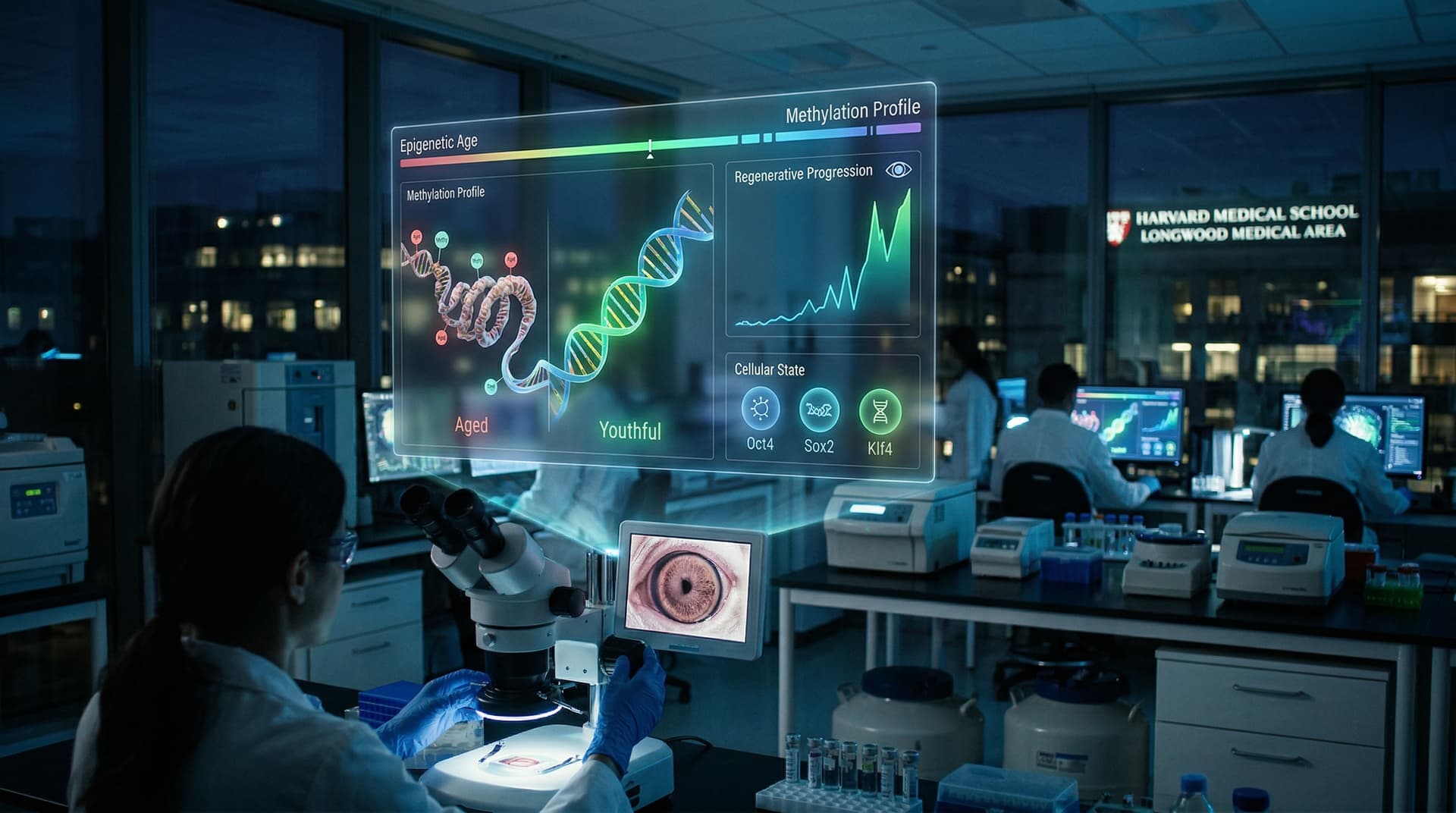
In a landmark achievement for longevity research, scientists at Harvard Medical School have demonstrated that partial cellular reprogramming can reverse age-related vision loss in mice. Published on June 3, 2024, in the prestigious journal Cell, the study led by David Sinclair reveals how injecting three Yamanaka factors—Oct4, Sox2, and Klf4 (collectively OSK)—into the eyes of blind mice triggered optic nerve regeneration and restored visual function. This isn't just a mouse miracle; it's a proof-of-concept that aging's epigenetic damage can be undone without erasing cellular identity, fueling hopes for human applications.
The Science of Epigenetic Aging
Aging is often described as the accumulation of damage, but Sinclair's lab subscribes to the information theory of aging: cells lose epigenetic information over time, like scratches on a DVD preventing proper readout of youthful instructions. The epigenome—chemical tags on DNA dictating gene expression—drifts, silencing regenerative genes and activating inflammatory ones.
Traditional Yamanaka factors (OSKM: Oct4, Sox2, Klf4, c-Myc), discovered by Shinya Yamanaka in 2006, can reset cells to pluripotency but risk tumors and loss of function. Sinclair's team refined this to OSK, omitting c-Myc to avoid cancer while achieving rejuvenation. Delivered via adeno-associated virus (AAV) vectors injected into the vitreous humor, OSK expression was controlled to last weeks, safely rewinding the epigenetic clock.
Study Details and Astonishing Results
The experiments targeted two models: middle-aged mice (1-1.5 years, equivalent to human 50s-60s) with optic nerve crush injury and mice with glaucoma-like optic neuropathy.
- Optic Nerve Regeneration: In crushed nerves, OSK-treated mice showed axons growing back over 1mm—five times farther than controls. Regenerated axons reached the brain's visual centers.
- Vision Restoration: Treated mice navigated mazes using visual cues, improving performance by 50-80% versus untreated. Electrophysiological tests confirmed heightened brain responses to light.
- Epigenetic Rejuvenation: Single-cell analysis revealed treated retinal ganglion cells shed decades of epigenetic age, reactivating youthful genes like Crim1 and Jun for growth.
No tumors formed, and off-target effects were minimal. "We've shown it's possible to restore vision by making old cells young again," Sinclair stated in a Harvard release.
Why This Matters for Longevity
Vision loss from glaucoma, macular degeneration, and optic atrophy affects 2.2 billion people globally, per WHO. Current treatments manage symptoms but don't regenerate tissue. This study proves reprogramming can instruct mature cells to repair themselves, bypassing stem cell transplants' immune issues.
Broader implications ripple across longevity:
- Multi-Organ Rejuvenation: OSK could target heart, brain, kidney failures.
- Systemic Aging: Combined with drugs like metformin or rapamycin, it might extend healthspan.
- Biohacking Potential: Safer vectors enable non-invasive delivery, hinting at eye drops or nanoparticles.
Expert Reactions and Context
The field buzzed. Aubrey de Grey of the Longevity Escape Velocity Foundation called it "a pivotal validation of damage-repair paradigms." Vadim Gladyshev, Harvard aging expert, praised the controls but noted mouse-to-human translation challenges like delivery efficiency.
Sinclair's work builds on prior feats: 2023 Salk Institute mice living 30% longer via reprogramming; Altos Labs' (Jeff Bezos-backed) safe OSK in primates. Competitors like Turn Biotechnologies (raised $128M) and Life Biosciences pursue similar paths. Finance-wise, reprogramming startups attracted $1B+ in 2023-2024, with ARCH Venture and ARCH Venture Partners leading rounds.
Challenges Ahead
Skeptics highlight gaps:
- Human Trials: AAV immunogenicity, dosing precision.
- Safety: Long-term OSK effects unknown.
- Scalability: Eye access is easy; systemic harder.
Regulatory hurdles loom—FDA views aging as non-disease—but orphan indications like glaucoma fast-track approvals. Sinclair's lab eyes human glaucoma trials in 2-3 years.
Investment and Industry Momentum
June 2024's study amplifies a hot sector. Longevity biotech funding hit $4.5B in 2023, per Longevitytech.report, with reprogramming a top category. Investors like Peter Thiel's Founders Fund back Sinclair spinouts. Public markets: Unity Biotechnology (senolytics) and others trade on Nasdaq, signaling maturation.
Events like the June 2024 Longevity Investors Conference underscored reprogramming's promise, drawing VCs eyeing 10x healthspan returns.
Toward Human Longevity
This isn't sci-fi. Restoring mouse vision at midlife suggests humans could regain faculties lost to time. Sinclair quipped, "If we can make blind mice see, what about fuzzy reading or memory?"
Biohackers already experiment with off-label OSK analogs, but clinical rigor is key. As tools refine, 2030s may see approved therapies, compressing morbidity.
Living Forever readers: Track Sinclair's Blueprint protocol, optimize NAD+, and watch reprogramming trials. The fountain of youth flows through epigenetics.
Word count: 912