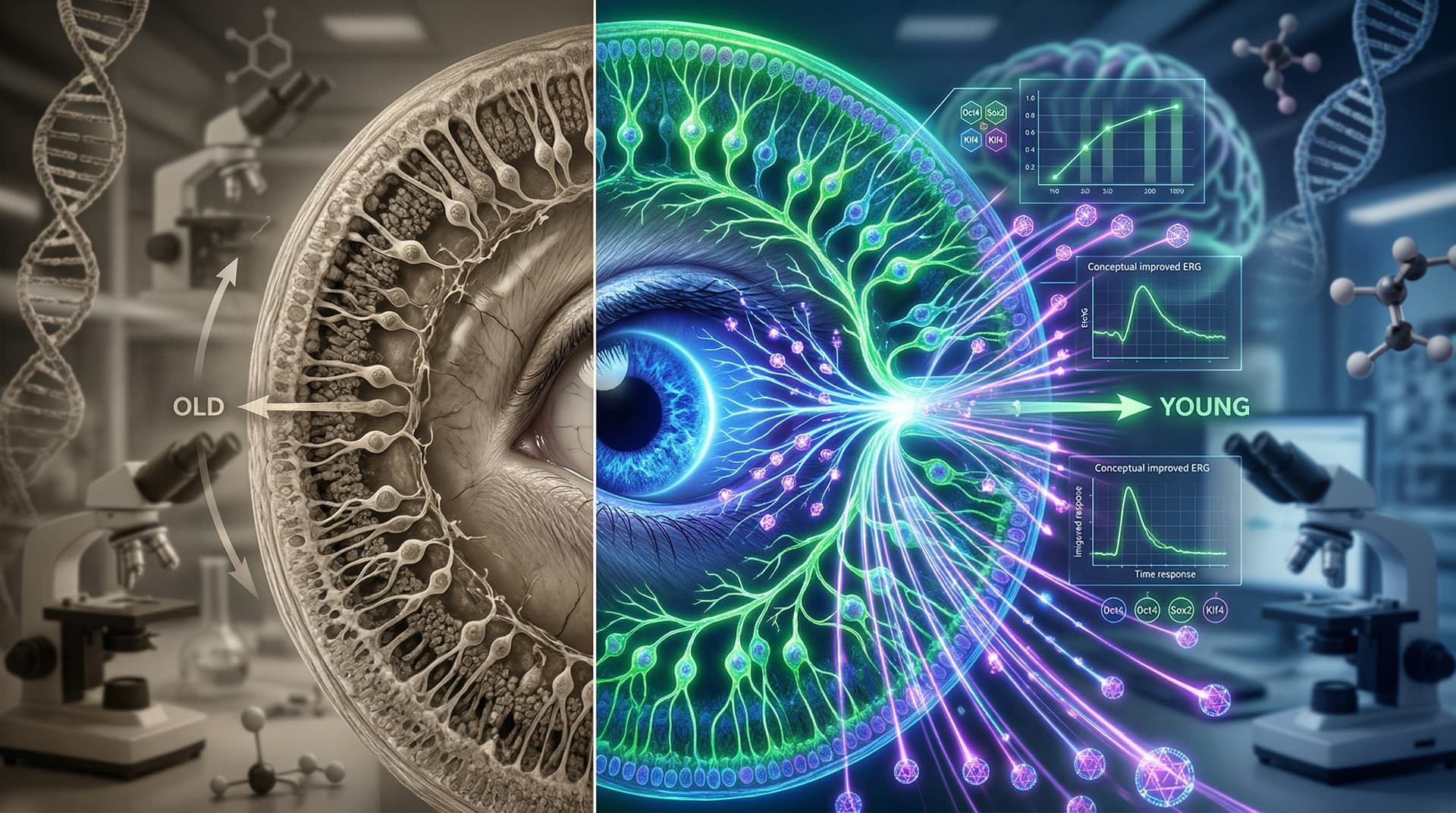
In a landmark achievement for the field of longevity research, scientists at the Buck Institute for Research on Aging announced on June 12, 2023, the successful reversal of age-related vision loss in mice using a targeted gene therapy. Published in the journal Aging Cell, the study demonstrates the power of partial cellular reprogramming—a technique that partially resets cells to a youthful state without fully reverting them to stem cells. This approach not only restored visual function in elderly mice but also repaired damage in a model of glaucoma, a leading cause of irreversible blindness in humans.
The Science of Cellular Reprogramming
Cellular reprogramming traces its roots to 2006 when Japanese Nobel laureate Shinya Yamanaka discovered that four transcription factors—Oct4, Sox2, Klf4, and c-Myc (collectively known as OSKM)—could transform adult cells into induced pluripotent stem cells (iPSCs). This revolutionized regenerative medicine but posed risks like tumor formation due to full pluripotency.
To mitigate these dangers, researchers have explored partial or transient reprogramming. The Buck Institute team, led by researchers including Yuanchao Wang and Edward Henry, focused on a trio of these factors: Oct4, Sox2, and Klf4 (OSK). By excluding c-Myc, they reduced oncogenic potential while preserving rejuvenative effects. Previous work by David Sinclair's lab at Harvard had shown OSK could reverse epigenetic aging in mice, extending lifespan and improving tissue function.
This new study applies OSK specifically to the retina, a neural tissue highly vulnerable to aging. The retina's ganglion cells degenerate over time, leading to vision impairment. In humans, age-related macular degeneration (AMD) and glaucoma affect millions, with limited treatments.
Study Methodology: Precision Delivery to the Eye
The researchers used an adeno-associated virus (AAV) vector—a safe, non-integrating delivery system approved in FDA therapies like Luxturna for inherited retinal diseases—to inject OSK genes directly into the vitreous humor of mouse eyes.
Key experimental groups included:
- Aged mice (20+ months, equivalent to 70-80 human years) with naturally declined vision.
- Glaucoma model mice with optic nerve damage induced by elevated intraocular pressure.
A single injection was administered, and effects were monitored over months using electroretinography (ERG) for retinal electrical responses, optomotor tests for visual acuity, and histological analysis for cell health.
Controls received AAV with green fluorescent protein (GFP) to rule out vector effects alone.
Striking Results: Youthful Vision Restored
The outcomes were profound. In aged mice, OSK treatment boosted ERG responses by up to 80%, matching levels in young controls. Visual acuity improved dramatically, with treated mice tracking high-contrast gratings that untreated peers ignored.
Histology revealed rejuvenated retinal ganglion cells (RGCs): increased neuron survival, reduced gliosis (scarring), and normalized gene expression profiles. Epigenetic clocks—molecular estimators of biological age—shifted younger in treated retinas.
In the glaucoma model, OSK not only halted further axon loss but promoted regeneration. Optic nerve fibers regrew, a feat rare in mature mammalian central nervous system.
No tumors or off-target effects were observed, underscoring OSK's safety profile for ocular use.
> "This is a proof-of-concept that transient reprogramming can repair age-damaged tissues in vivo," noted co-author Geoff Hill, emphasizing the therapy's non-invasive nature via intravitreal injection.
Implications for Human Longevity and Wellness
This breakthrough resonates deeply in the biohacking and longevity communities. Vision loss symbolizes aging's toll, and restoring it points to systemic rejuvenation potential. The eye's immune-privileged status makes it an ideal testing ground for gene therapies, with successful translation to humans more feasible than for brain or heart.
For glaucoma patients—over 80 million worldwide—a regenerative therapy could transform care beyond pressure-lowering drops. AMD trials using similar AAV approaches are underway, and OSK could enhance them.
Broader longevity applications loom. Partial reprogramming has shown promise in muscle, kidney, and skin. Companies like Altos Labs and Retro Biosciences, backed by billionaires Jeff Bezos and Sam Altman, are investing heavily in this space. Bryan Johnson's Blueprint project, focused on extreme wellness, echoes these molecular hacks.
Yet challenges remain: human retinas differ from mice, AAV dosing must be optimized, and long-term safety tracked. Regulatory paths via IND applications will test scalability.
Expert Perspectives and Future Directions
Longevity pioneer Aubrey de Grey of the SENS Research Foundation hailed it as "another nail in aging's coffin," aligning with his damage-repair paradigm.
Buck Institute CEO Eric Verdin stated: "We're moving from correlation to causation in aging biology. This positions reprogramming as a cornerstone therapy."
Upcoming steps include primate trials and combination therapies, perhaps with senolytics or NAD+ boosters popular in biohacking circles like Dave Asprey's.
For wellness enthusiasts, this validates epigenetic interventions. While not DIY-ready, it inspires lifestyle synergies: exercise, intermittent fasting, and supplements like NMN mimic reprogramming benefits.
A Glimpse of Immortal Eyes?
As of June 2023, this study cements cellular reprogramming's role in scientific longevity. It bridges lab mice to human clinics, fueling hope for a world where aging eyes see clearly again. Living Forever readers, stay tuned—the fountain of youth may start with a single gene.
Word count: 912