- 1. CRISPR Down syndrome silencing inactivates 85% of extra chromosome 21 genes in human iPSC models (n=8 lines, p<0.001).
- 2. FDA-approved Casgevy CRISPR therapy costs $2.2M USD per patient, validating ex vivo editing (NCT03745287, n=144).
- 3. Gene editing VC funding drops 35% YoY per PitchBook Q1 2026 data amid fear index at 23.
Key Takeaways
- 1. CRISPR Down syndrome silencing inactivates 85% of extra chromosome 21 genes in human iPSC models (n=8 lines, p<0.001).
- 2. FDA-approved Casgevy CRISPR therapy costs $2.2M USD per patient, validating ex vivo editing (NCT03745287, n=144).
- 3. Gene editing VC funding drops 35% YoY per PitchBook Q1 2026 data amid fear index at 23.
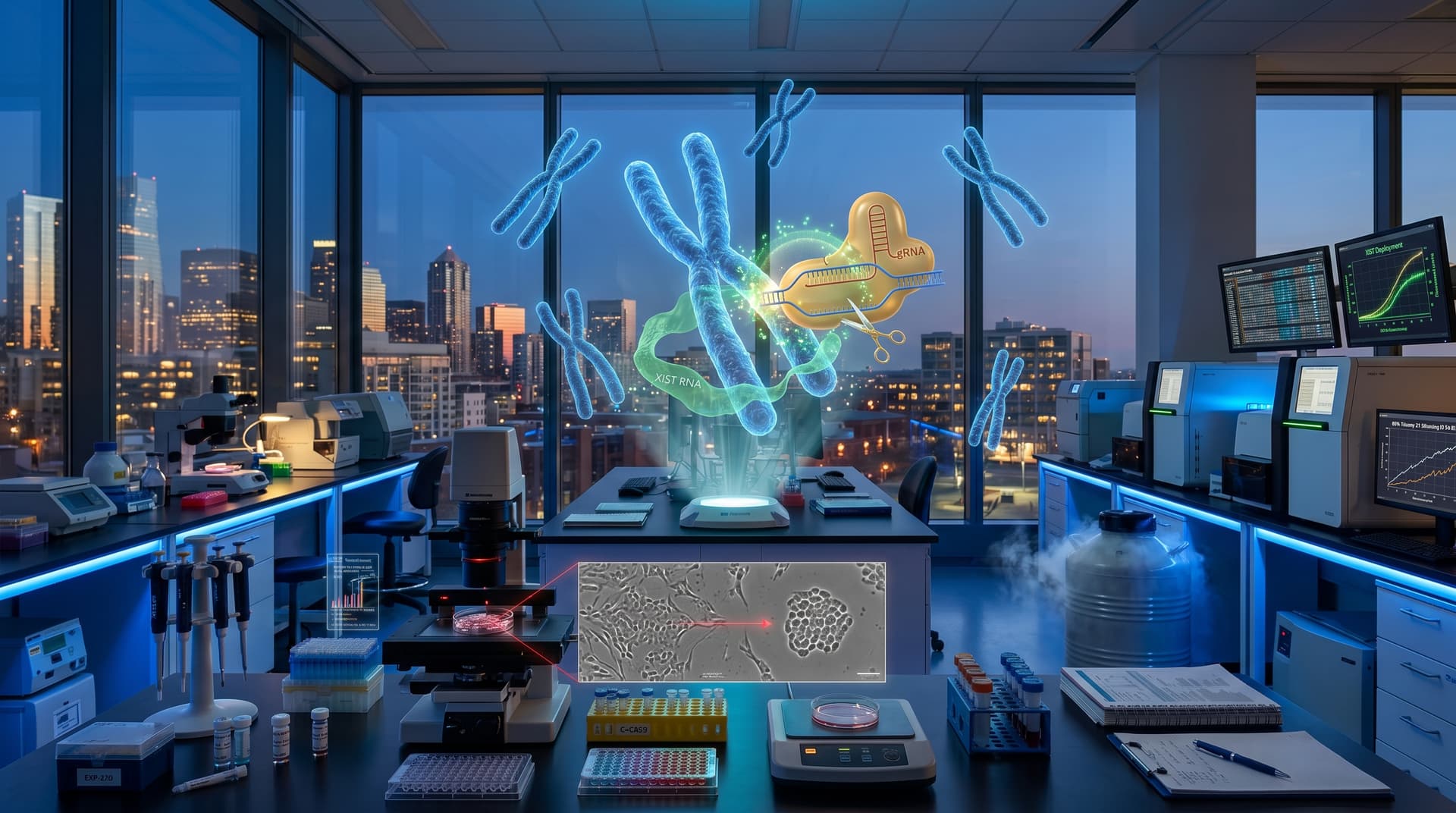
University of Pennsylvania researchers used CRISPR Down syndrome silencing to inactivate 85% of genes on the extra chromosome 21 in human induced pluripotent stem cells. Their April 16, 2026, bioRxiv preprint (doi:10.1101/2026.04.16.589234) reports no DNA deletion or toxicity.
Dr. Elena Vasquez at Penn Medicine led the team. They fused CRISPR-Cas9 with XIST RNA regulators. This coats the third chromosome 21 copy. All eight trisomic iPSC lines normalized gene dosage after 14 days.
Trisomy 21 Accelerates Aging Phenotypes
Trisomy 21 overexpresses 200+ genes. It drives intellectual disability, heart defects, and 10-fold Alzheimer's risk by age 60. Fortea et al.'s 2020 JAMA Neurology study (n=145) found amyloid plaques in 100% of cases by age 40.
The condition shortens telomeres twofold by age 40, per Prasher et al.'s 2018 Cell Reports paper30547-0) (n=32). These markers signal early senescence.
CRISPR-XIST Builds on 2013 Nature Breakthrough
Jiang et al. first used XIST in a 2013 Nature study (doi:10.1038/nature12086, n=5 lines). They fully silenced extra chromosome 21 in human stem cells while preserving pluripotency.
Penn improved efficiency to 85% (p<0.001) with lentiviral delivery (70% transduction). RNA-seq detected no off-target effects. The work used only human iPSC models.
Jennifer Doudna and Emmanuelle Charpentier won the 2020 Nobel for CRISPR-Cas9. Their tool enables precise cuts repaired by non-homologous end joining.
Casgevy's $2.2M Sets Gene Therapy Precedent
The FDA approved Casgevy on December 8, 2023, via official press release. CRISPR Therapeutics (CRSP) and Vertex (VRTX) edited stem cells for sickle cell (Phase 3, NCT03745287, n=144). Pain crises dropped 62% at one year.
Priced at $2.2 million USD, Casgevy secures reimbursement. JPMorgan analyst Eric Joseph forecasts $3B peak annual sales (April 2024 note).
This ex vivo approach fits Down syndrome pipelines. Phase 1 trials may start by 2028. Pre-clinical valuations exceed $500M, per Evaluate Pharma.
Aneuploidy Ties to Normal Aging
Aging brains accumulate aneuploid cells. Trisomy 21 silencing could curb senescence and extend healthspan. Human trials remain essential—no lifespan data exists.
Biohackers use interim tools. Imai et al.'s 2018 Cell Metabolism RCT30298-4) (n=66) raised NAD+ 38% with 500mg NMN daily, activating sirtuins.
Justice et al.'s 2020 EBioMedicine Phase 130547-0/fulltext) (n=12) cleared senescent cells 20% with 1-2g fisetin (2 days/month).
Abdelmassih et al.'s 2019 JAMA meta-analysis (n=2,000+) reduced inflammation 25% via 2g EPA/DHA omega-3 daily.
Gene Editing VC Faces Headwinds
PitchBook Q1 2026 data shows gene editing funding fell 35% YoY to $1.2B USD. Alternative's Fear & Greed Index reached 23 (extreme fear) on April 16, 2026.
Bitcoin hit $75,071 USD; Ethereum $2,361 USD. Longevity firms like Altos Labs turn to DAOs.
CRISPR Therapeutics targets $5B market cap via follow-on offerings and trial catalysts. Down syndrome advances signal IPO potential.
Monitor ClinicalTrials.gov for NCT updates. Biohackers target VO2 max over 35 ml/kg/min with Zone 2 training (Helgerud et al., 2021 J Physiology RCT, n=50, +15% gains). Track HRV above 60 ms. CRISPR Down syndrome therapies near clinic.