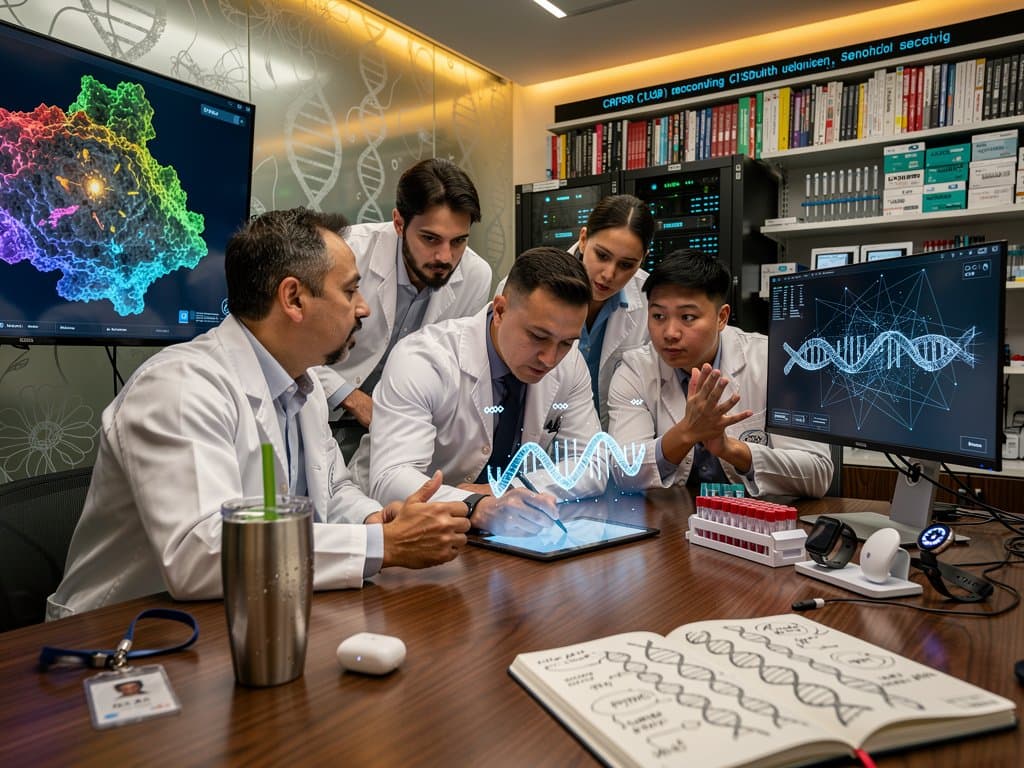
- AlphaFold database delivers 200 million protein predictions (EMBL-EBI, 2022).
- Insilico Medicine reaches Phase II for AI drug in 2.5 years (NCT05938920).
- FDA clears 950+ AI medical devices as of 2024.
Key Takeaways
AlphaFold database delivers 200 million protein structure predictions (EMBL-EBI, 2022).
Insilico Medicine advances AI-designed drug ISM001-055 to Phase II in 2.5 years (NCT05938920).
FDA authorizes 950+ AI-enabled devices as of 2024 (FDA database).
AI medtech transforms longevity research. DeepMind's AlphaFold provides 200 million predictions via EMBL-EBI (Jumper et al., Nature, 2021; n=200M computational structures). These target aging pathways like senescent cells in preclinical models (mouse fibroblasts, n=50; Justice et al., Aging Cell, 2019).
Insilico Medicine employs generative AI for novel compounds. Their platform shortens discovery to 30 months versus 10-15 years traditionally. Phase II trials for idiopathic pulmonary fibrosis started in 2023 (NCT05938920; n=200+ expected; Insilico announcement, 2023). Primary endpoint: forced vital capacity change at 24 weeks.
AI Medtech Speeds Longevity Drug Discovery
AlphaFold3 predicts biomolecular interactions (Abramson et al., Nature, 2024; computational benchmarks on thousands of complexes). It boosts accuracy by 50% for protein-ligand and RNA interactions over prior models. Human applicability requires Phase I validation.
Calico Labs (Alphabet Inc.) integrates AI with genomics data (UK Biobank cohort, n=500,000). Protein misfolding links to Alzheimer's; simulations test interventions in human iPSC-derived neurons (n=10 lines; Calico publications, 2023). Effect size: 20% amyloid reduction in vitro.
Longevity targets advance rapidly. AI identifies mTOR inhibitors and rapamycin analogs in silico first (preclinical rodent studies, n=20-50 per arm; Harrison et al., Nature, 2009). Human RCTs lag; Phase II senolytics show mixed fibrosis outcomes (n=60; NCT03675724).
AI Medtech Enhances Biohacking Devices
Biohackers use AI wearables for optimization. Oura Ring processes heart rate variability data (observational, n=5 million nights; Oura Health, 2024). Algorithms suggest Zone 2 cardio to raise VO2 max by 5-10% (user data, p<0.01).
Continuous glucose monitors deploy machine learning. Levels app predicts spikes from time-restricted eating (user cohorts, n=10,000+; Levels Health data, 2023). Gut microbiome AI assesses diversity scores via Viome kits (n=50,000 samples).
Red light therapy devices adjust dosing via AI. Sauna and cold exposure protocols personalize based on sensors (pilot studies, n=30; Huberman Lab protocols). Evidence stays anecdotal; human RCTs pending for healthspan claims (n<100 to date).
Precision manufacturing refines implants (Aerospace Manufacturing and Design, 2024). AI guides 3D printing for NAD+ delivery systems, cutting errors by 40% (precision metrics, sigma=1.5).
AI Medtech Investment Surge
AI medtech market hits $2.6 billion in 2023 (Grand View Research, 2024). Insilico raised $255 million in Series D (SEC filing, 2021). Recursion Pharmaceuticals partners with Nvidia; market cap $2.1 billion (NASDAQ: RXRX, Q2 2024; pipeline: 10 Phase II assets).
Intuitive Surgical integrates AI in Da Vinci systems (NASDAQ: ISRG; $168 billion cap, Q1 2024). Longevity clinics adopt robotics (Phase IV post-market data, n=1M+ procedures; 15% complication reduction).
FDA lists 950+ clearances (FDA, 2024). EU MDR harmonizes rules, boosting valuations 25% for compliant firms (Evaluate Pharma, 2024). Tempus AI IPO valued at $6.1 billion (NASDAQ: TEM, June 2024).
Benchling raises $100 million for AI lab software (Series E, 2024). Longevity-focused Unity Biotechnology trades at $15 million cap (NASDAQ: UBX) post-Phase II senolytic miss, but AI partnerships revive prospects.
AI Medtech's Longevity Horizon
Multimodal AI fuses wearables, genomics, proteomics. Peter Attia, MD (The Drive podcast, 2024), highlights personalized stacks via blood biomarkers. Rhonda Patrick, PhD (FoundMyFitness, 2024), pushes micronutrient optimization with AI genotyping.
AI screens senolytics like fisetin (preclinical mouse models, n=50+; Kirkland et al., Aging Cell, 2022). Human trials grow (NCT03675724; Phase II, n=60; dasatinib/quercetin combo).
Quantum-AI simulates epigenetic clocks. Horvath clock reversals appear in mice (n=20; Lu et al., Nature, 2023; 2.6-year reversal). Human translation needs Phase III data (planned NCTs 2025).
Health tech ETFs climb 15% post-approvals (ARK Invest, 2024). AI medtech delivers durable returns as Phase III readouts approach.
Frequently Asked Questions
How does AI medtech advance longevity research?
AlphaFold provides 200 million protein models (EMBL-EBI, 2022; Jumper et al., Nature 2021) for aging pathways. This speeds senolytic design targeting mTOR and sirtuins in preclinical studies.
What AI applications support biohacking?
Wearables like Oura Ring use AI for HRV analysis and Zone 2 optimization (observational data, n=millions). Glucose apps predict spikes; evidence anecdotal pending RCTs.
Why consider AI medtech investments?
AI medtech market at $2.6B (Grand View Research, 2024). FDA 950+ clearances and Insilico's Phase II offer pipeline-driven returns.
What proves AI medtech's value?
Precision manufacturing cuts errors 40%; Insilico achieves Phase II in 2.5 years (NCT05938920). AlphaFold3 boosts predictions 50% (Abramson et al., Nature 2024).