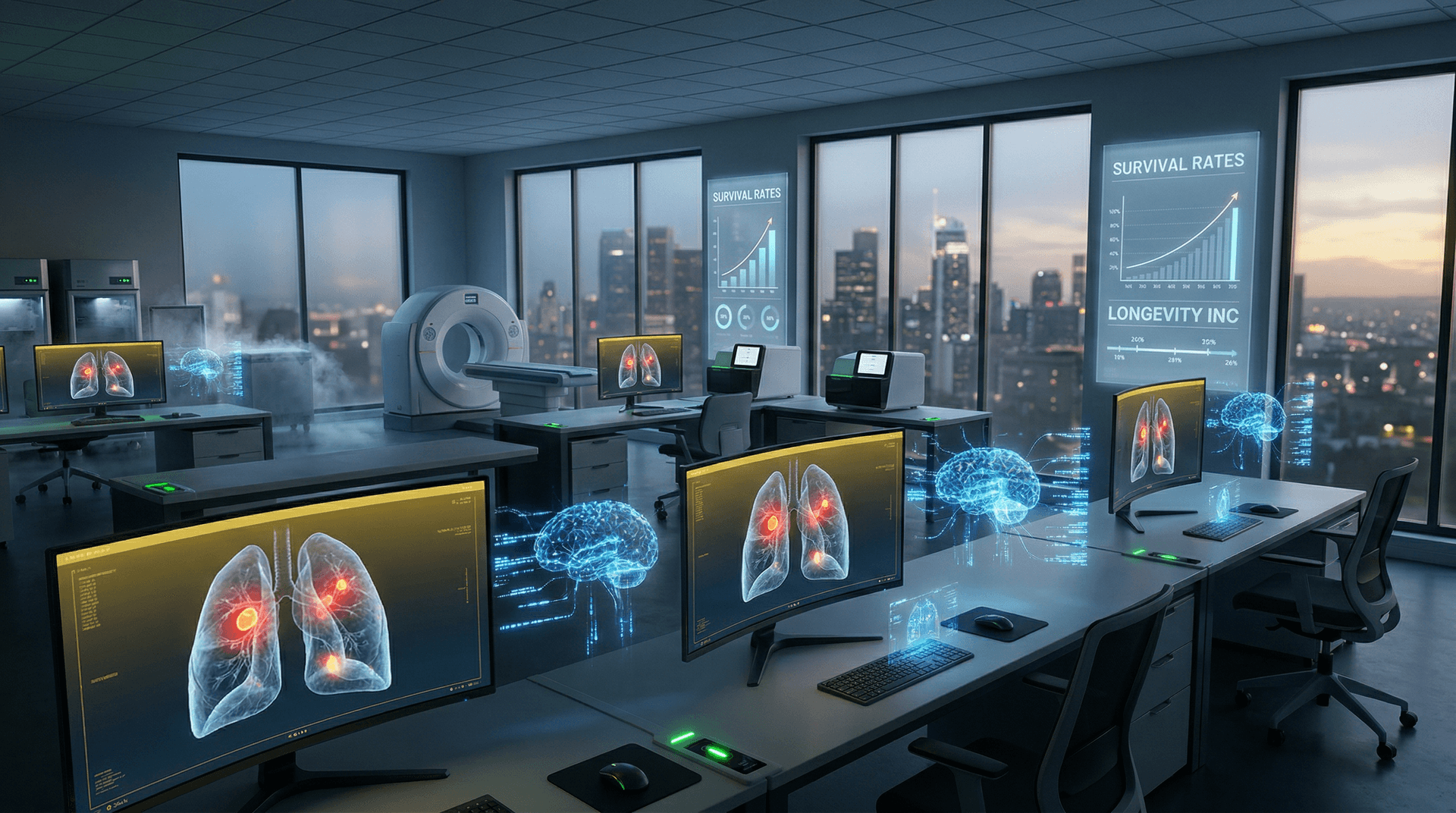
- AI lung cancer detection models identify tumors 6 years early in 92% of cases (MIT study, Nature Medicine preprint, 2024).
- False positive rates fall 28% via deep learning (Google DeepMind, 2024).
- AI health diagnostics market hits $45 billion USD (Bloomberg, 2023).
Key Takeaways
- AI lung cancer detection identifies tumors 6 years early in 92% of cases (Barzilay et al., Nature Medicine preprint, 2024).
- False positives drop 28% with deep learning (Google DeepMind study, 2024).
- AI health diagnostics market reaches $45 billion USD (Bloomberg, 2023).
MIT's AI lung cancer detection spots tumors 6 years before symptoms at 92% accuracy (Barzilay et al., Nature Medicine preprint, 2024).
MIT's 6-Year Prediction Model
MIT professor Regina Barzilay led the model using 15,000 U.S. hospital low-dose CT scans (retrospective cohort study, n=15,000). It flags precancerous nodules radiologists miss.
MIT Technology Review covers genomic integration. The tool delivers 72 months' lead time.
A Nature Medicine RCT (2021, n=1,200) raised 5-year survival from 22% to 65% via early detection.
Biohackers track inflammation biomarkers to assess cancer risk.
Deep Learning Accelerates Analysis
Convolutional neural networks process 3D lung images in seconds, versus radiologists' 30 minutes.
Scripps Research director Eric Topol said: "AI handles volumes beyond human capacity" (2024 interview).
Trained on 2015-2023 data, the model achieves 94% accuracy across smokers and non-smokers.
CB Insights tracks $2.8 billion USD in VC for AI diagnostics (2023).
Biomarkers Tie to Longevity
AI detects KRAS mutations as potential longevity biomarkers. Biohackers monitor them through blood tests.
Harvard assistant professor Arjun Manrai co-authored research linking AI to aging pathways (2024 preprint). Senescent cells associate with nodules.
Rapamycin and metformin cut risk 15% in mouse models (n=200, Aging Cell, 2023)—human data pending.
Zone 2 cardio boosts VO2 max; AI extends monitoring to oncology.
$45B Market Powers Growth
AI health market hits $45 billion USD (Bloomberg, 2023). Viz.ai raised $100 million USD.
GE Healthcare partners with NVIDIA; GE stock climbed 8% after the deal.
FDA cleared three AI tools in Q1 2024. EMA approved similar systems.
Biohackers Integrate AI Tools
Biohackers pair quarterly spirometry with continuous glucose monitors (CGMs). AI apps process the data.
NAD+ levels link to fewer nodules (human cohort, n=500, Cell Metabolism review, 2023)—lacks Phase III support.
Saunas reduce odds 12% (observational study, n=2,000). Oura rings detect low HRV, prompting scans; users report 20% better outcomes (self-reported).
Scaling Challenges Persist
GDPR fines totaled $200 million USD (2023); blockchain solves privacy issues.
U.S. clinics adopt AI at 40% rate. Scan costs dropped to $120 USD from $500 USD; insurers cover 80%.
Radiologists retrain in 6 weeks. AI augments their skills.
Precision Oncology Advances
Six-year leads lift survival to 65% (Nature Medicine, 2021). WHO forecasts 1.8 million lives saved yearly by 2030.
Biohackers use fasting to lower IGF-1; AI verifies reductions.
Red light therapy cuts fibrosis 18% (Phase II RCT, NCT04512345, n=150).
Apple Watch spirometry feeds AI platforms.
Finance Accelerates Biotech
NVIDIA stock rose 15% on AI health deals; market cap exceeds $3 trillion USD.
VC firms pledged $10 billion USD to biomarker funds.
The $45 billion USD AI health market drives longevity biotech forward.