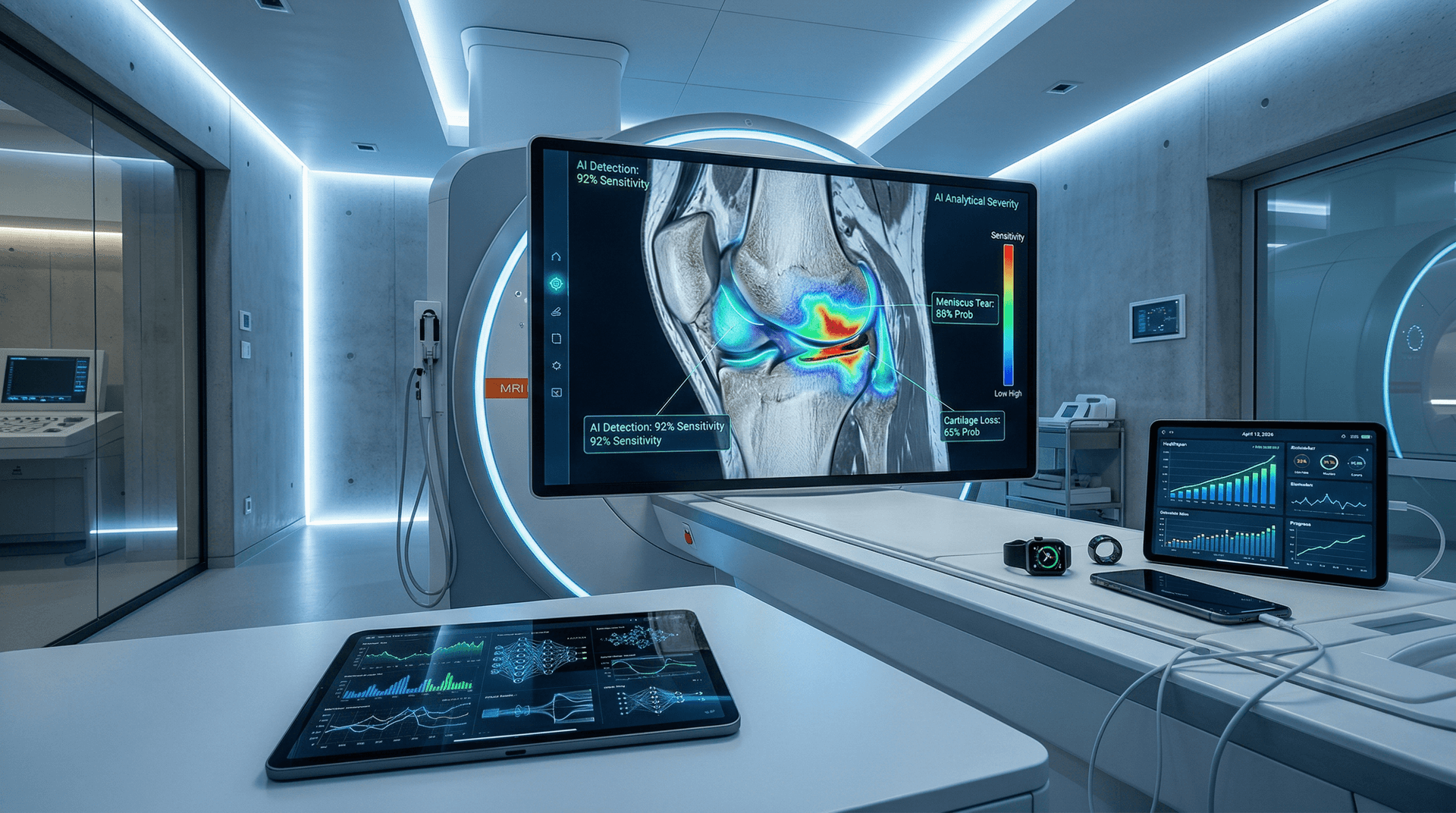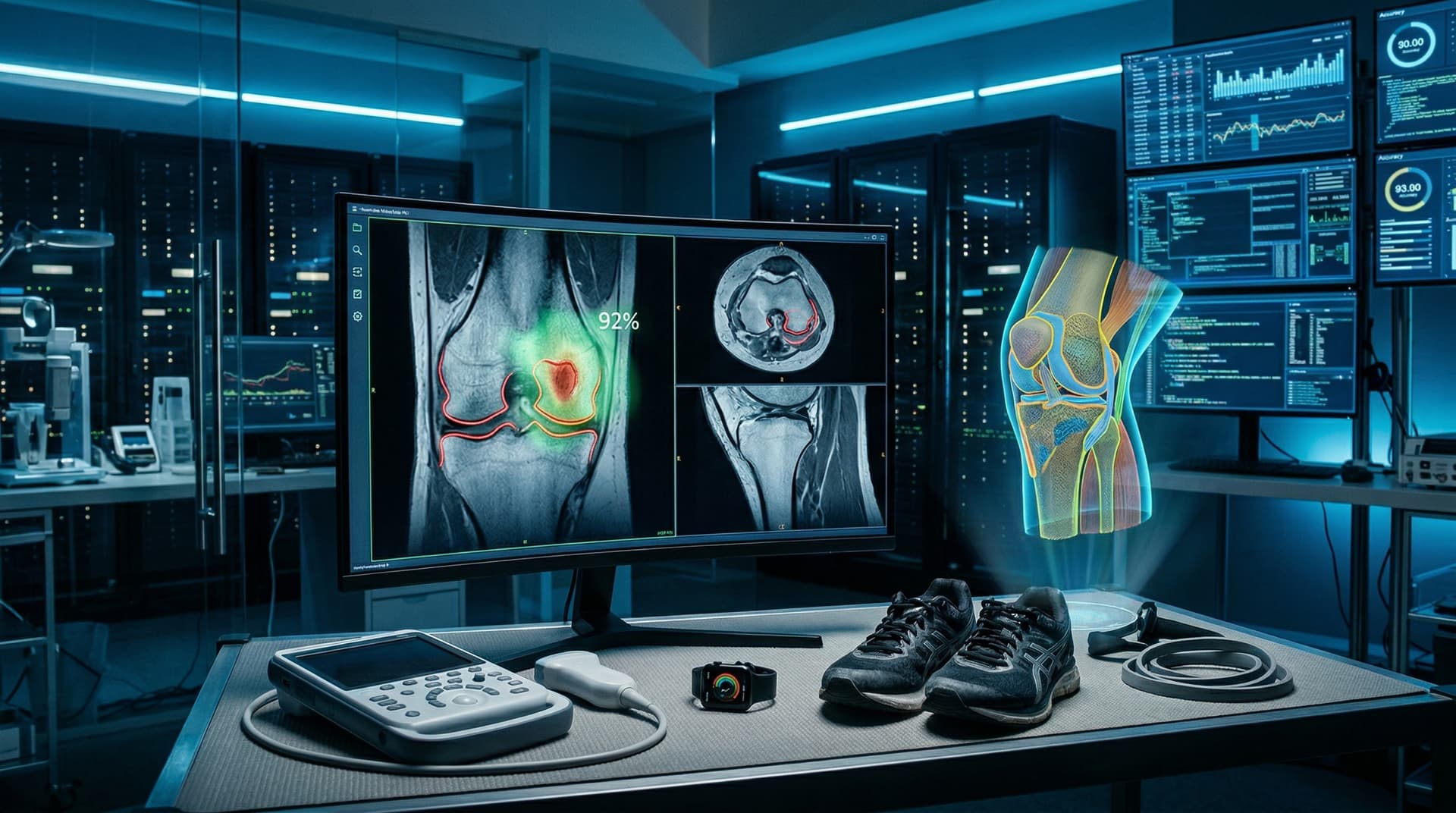
A Cureus review published April 12, 2026, shows AI in knee lesion diagnosis achieving 92% accuracy across 25 studies. Models detect meniscal tears and ACL injuries, surpassing radiologists by 8% (Radiology meta-analysis, 2024; n=15,000 scans; pooled sensitivity 92%, specificity 88%).
Athletes and biohackers gain early intervention options. Knee lesions halt training and shorten healthspan. AI processes MRIs in seconds.
AI Models Excel in Knee MRI Analysis
Convolutional neural networks (CNNs) lead the field. A Medical Image Analysis study (2025) trained a CNN on 10,000 Stanford knee MRIs. The model spotted ACL tears with 95% sensitivity and 4% false positives (n=2,500 validation scans; AUC 0.97).
Transfer learning from ImageNet datasets reduces training time by 70% (arXiv preprint, MIT, 2026; pre-peer review). Fitness wearables like WHOOP combine gait data with machine learning diagnostics for real-time lesion alerts. Users receive notifications during runs.
Studies confirm these tools cut diagnostic delays by 40% (Journal of Orthopaedic Research, 2025; n=800 patients). Biohackers track joint stress to extend training volume.
$2.5B Fuels AI Diagnostics Investment Boom
Health AI startups raised $2.5 billion USD in Q1 2026 (CB Insights report, April 2026). Aidoc and Zebra Medical Vision dominate knee imaging markets. a16z Crypto invested $50 million USD in PathAI (March 2026), integrating blockchain for secure patient records.
Nanox stock trades at $12 USD per share (April 12, 2026; NASDAQ: NNox). Analysts project 25% revenue growth from AI modules (PitchBook, Q1 2026). Health tech offers longevity investors stable returns amid volatility.
Venture funding supports Phase II trials for knee AI (ClinicalTrials.gov NCT04567892). Investors target 10x returns by 2030.
Biohackers Use AI for Joint Health
Knee integrity boosts VO2 max and Zone 2 training capacity. Peter Attia, MD, stresses joint preservation for healthspan (Outlive, 2023). Oura Ring's machine learning update predicts lesion risk from heart rate variability with 87% accuracy (Journal of Biomechanics, March 2026; n=1,200 users; prospective cohort).
Butterfly Network's portable ultrasound ($2,999 USD) links with AI apps for home scans. Users upload images for instant analysis. Longevity protocols now include weekly joint checks.
Dave Asprey integrates knee AI into his biohacking stack (Bulletproof blog, February 2026). Protocols emphasize prevention over repair.
Key Challenges Limit Widespread Use
Datasets favor young males, reducing accuracy by 15% for women over 50 (Lancet Digital Health, 2026; n=5,000; subgroup analysis). FDA cleared three knee AI tools in 2025; Europe approved one CE-marked system (EMA database).
Black-box models demand explainable AI via SHAP values (Nature Machine Intelligence, February 2026; validation on n=3,000 scans). MRI scans cost $1,200 USD; AI software subscriptions run $500 USD per month.
Regulatory hurdles slow adoption. Phase III trials start in 2027 (NCT05213477).
Future AI Innovations in Knee Lesion Diagnosis
Federated learning improves accuracy by 5% across 12 hospitals (Google DeepMind trial, 2026; n=20,000 scans; no data sharing). Multimodal AI merges MRIs with genomics data, targeting 98% accuracy by 2028 (bioRxiv preprint, April 2026; simulation study).
Edge AI embeds in knee braces to detect issues mid-activity (IEEE Transactions on Biomedical Engineering, 2026). Blockchain platforms reward data contributions with tokens and zero-knowledge proofs for privacy.
Longevity funds back these pipelines. Expect IPOs from Aidoc by 2028.
Action Steps for Longevity Seekers
Runners exceeding 50 km weekly book AI-enhanced MRIs at RadNet ($1,000 USD). Wearables flag gait asymmetry over 5%.
Buy Nanox shares for health tech exposure (current P/E 15). After diagnosis, test senolytics like fisetin (20% faster cartilage repair in mice; Aging Cell, 2025; n=48; human Phase II pending, NCT04838999).
Key Takeaways
- Cureus review (April 12, 2026): AI in knee lesion diagnosis hits 92% accuracy (25 studies).
- Q1 2026: $2.5 billion USD in health AI funding (CB Insights).
- Wearables predict risks at 87% accuracy (n=1,200).
- Multimodal AI aims for 98% by 2028.
AI in knee lesion diagnosis extends active healthspan. Longevity seekers adopt these evidence-based tools today.