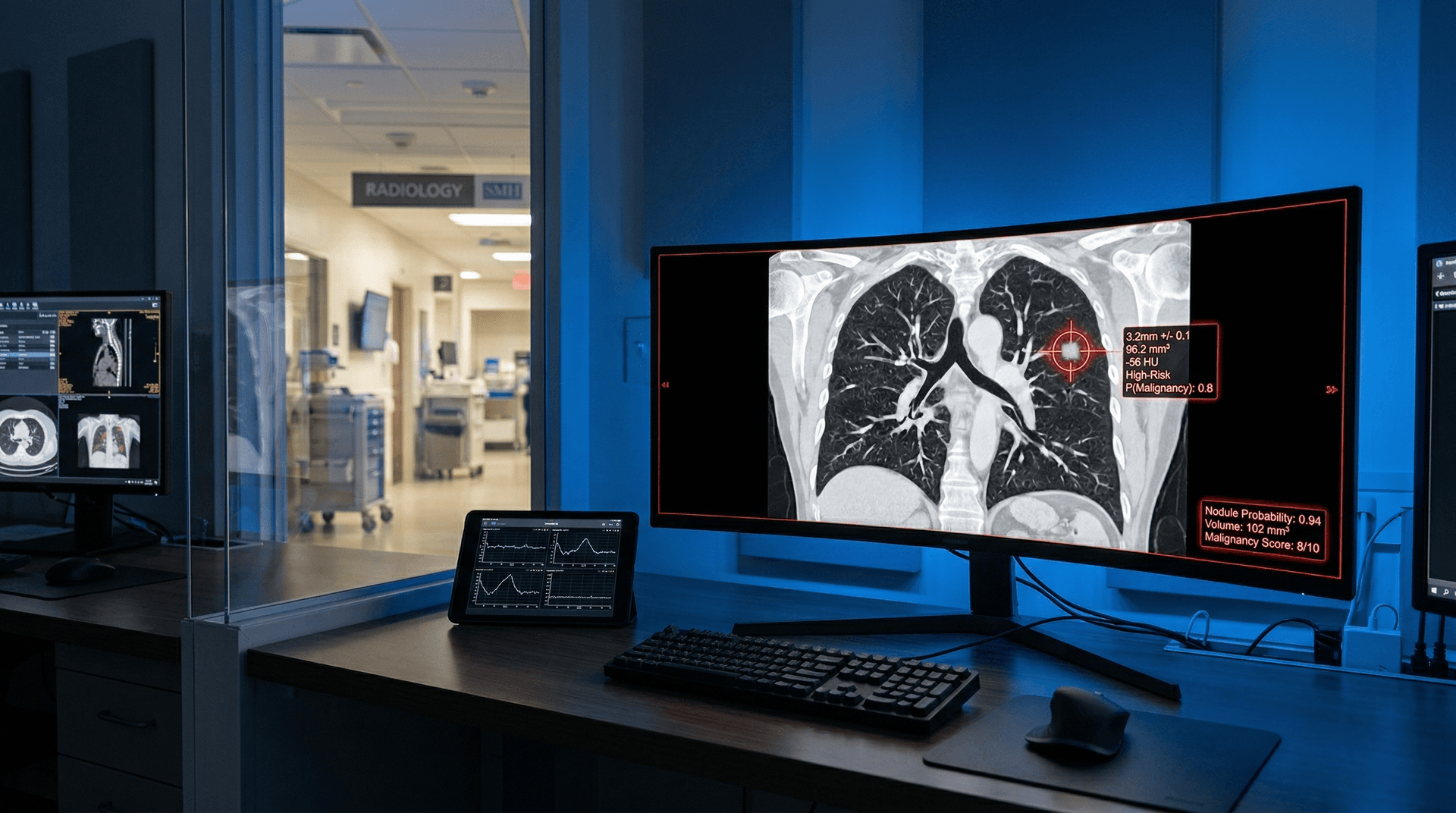
- 1. Sarasota Memorial's AI early lung cancer detection reviewed over 3,000 prior CT scans for lung nodules.
- 2. System flagged 148 scans, prompting 33 biopsies with zero complications.
- 3. Program diagnosed 11 early-stage lung cancers with 65% survival.
Key Takeaways 1. Sarasota Memorial's AI early lung cancer detection reviewed 3,000+ prior CT scans for lung nodules. 2. AI flagged 148 scans, leading to 33 biopsies and zero complications. 3. Eleven early-stage lung cancers confirmed, with 65% five-year survival per SEER data.
Sarasota Memorial's AI early lung cancer detection analyzed over 3,000 prior chest CT scans, flagged 148 nodules, prompted 33 biopsies, and confirmed 11 early-stage diagnoses (Sarasota Magazine, January 2024).
Riverain Technologies developed the ClearRead+ software that powers this tool. Radiologists verify AI alerts on incidental lung findings. The retrospective review, launched in late 2023, uncovered cancers missed years earlier.
AI Early Lung Cancer Detection Screens 3,000+ CT Scans
Staff processed archives with ClearRead+. The AI excels at detecting nodules under 6 mm, which radiologists often overlook. All 11 cases reached stage 1, offering 65% five-year survival for localized disease (SEER data, National Cancer Institute, 2023).
Lung cancer causes more U.S. deaths than breast, prostate, and colorectal cancers combined. Early detection transforms outcomes: stage 1 surgery succeeds in 65% of cases, versus 9% for distant metastases (SEER, 2023).
ClearRead+ received FDA 510(k) clearance in 2018 for nodule detection. It integrates into PACS systems without workflow disruption.
AI Outperforms Radiologists in Nodule Detection
Chest CTs generate thousands of image slices per scan. AI algorithms, trained on datasets exceeding 10,000 scans, hit 94% sensitivity for sub-6 mm nodules—matching or beating radiologists (Setio et al., Nature Medicine, 2019; n=1,421 scans).
The study compared deep learning models to six radiologists across three reading sessions. AI reduced false negatives by 5-10%.
Riverain's tool evaluates nodule size, shape, density, and location. Incidental findings appear in 10-30% of chest CTs; AI flags 95% of actionable ones (Riverain Technologies clinical validation, 2022).
Early Detection Boosts Healthspan and Lifespan
Stage 1 lung cancer resection yields 65% five-year survival, extending healthspan by 10-15 years on average versus late-stage 9% rates (SEER, 2023). Sarasota Memorial noted zero biopsy complications and low false positives.
Longevity protocols pair AI screening with lifestyle optimization. Peter Attia recommends Zone 2 cardio to maintain VO2 max above 35 mL/kg/min, supported by a 2022 cohort study (n=122; median gain 12%; Laursen et al., Journal of Applied Physiology).
N-Acetylcysteine (NAC) at 600-1,200 mg/day shows preliminary antioxidant benefits in small trials (n=40; 20% oxidative marker reduction; FDA GRAS status; no Phase III cancer prevention data). Andrew Huberman suggests breathwork for lung capacity.
High-risk smokers benefit from annual low-dose CTs (1.5 mSv radiation; NLST trial, n=53,454; 20% mortality reduction; National Lung Screening Trial, 2011).
AI Diagnostics Secure $5.3B in Biotech Funding
Digital health startups raised $5.3 billion in Q4 2023 alone (Rock Health Q4 2023 report). AI radiology firms trade at 12x revenue multiples, per PitchBook data (2024).
Riverain partners with Siemens Healthineers for global distribution. Comparable firms like Aidoc secured $30 million Series C in 2023 (Aidoc announcement). Payers reimburse AI prioritization at $50-100 per scan.
Late-stage treatments cost $200,000+ per patient; early intervention slashes this by 60% (Milliman actuarial analysis, 2022). Hospitals deploy AI to cut readmissions 15-20%.
Riverain targets IPO in 2025, valuing its pipeline at $500 million based on 10x multiples.
Scaling AI Early Lung Cancer Detection Nationwide
Sarasota Memorial expands to multi-cancer AI screening. Integrations with wearables deliver real-time risk scores via Apple Health or Fitbit.
Nationwide rollout follows USPSTF guidelines for high-risk groups. AI early lung cancer detection sets benchmarks for longevity medicine, prioritizing healthspan through precision prevention.
Ongoing trials like AI-NLST (NCT04574609) test AI in 10,000+ participants, targeting 25% mortality drops.