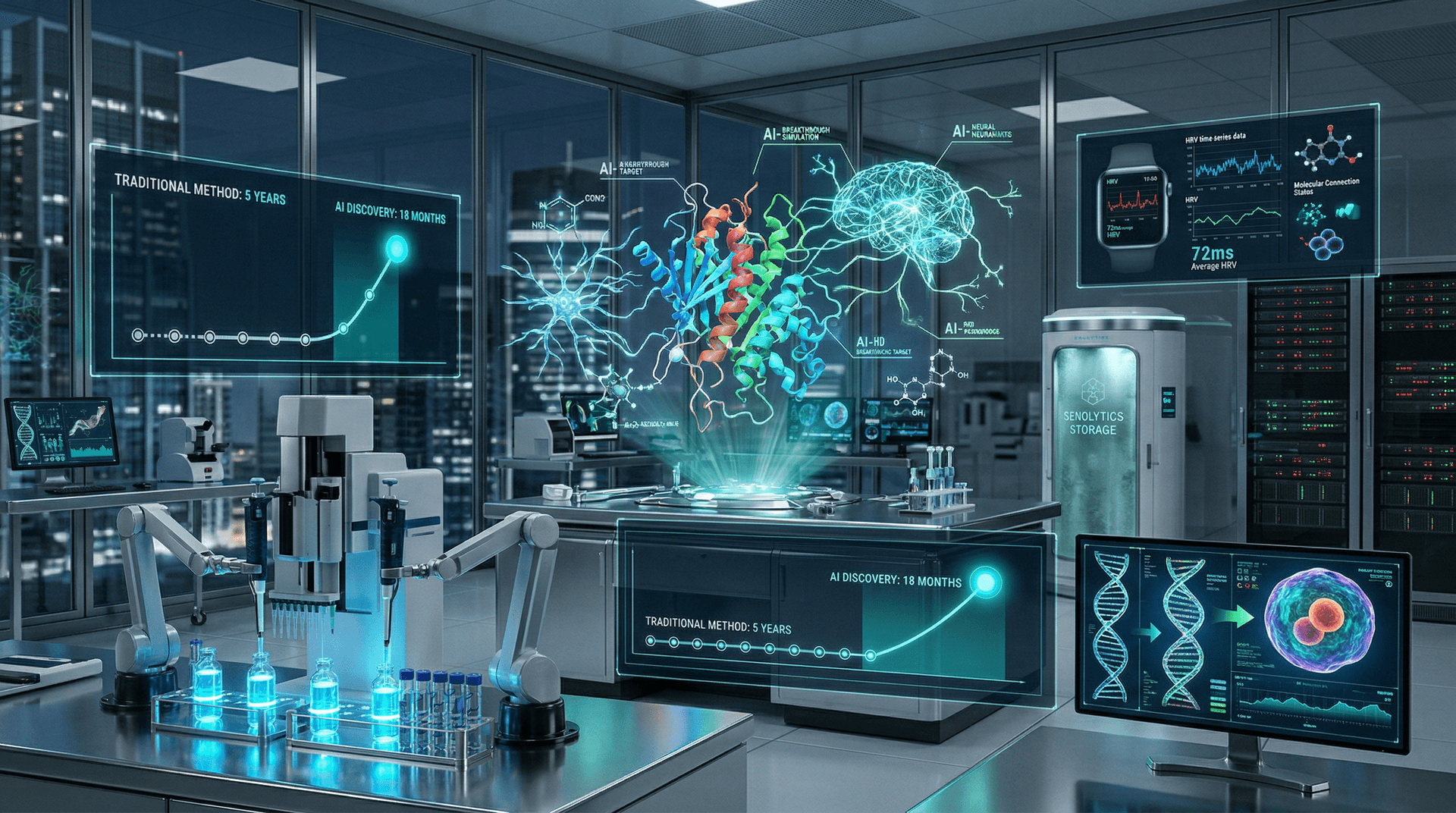
- AI drug discovery cut Insilico Medicine's lead compound time to 18 months from 5 years, per founder Alex Zhavoronkov.
- AlphaFold 3 achieves 99% accuracy on human protein structures within 1 angstrom, Nature study (Abramson et al., 2024).
- AI longevity startups raised $3.2 billion across 150 deals in 2025, PitchBook data shows.
Key Takeaways
- AI drug discovery cut Insilico Medicine's lead compound time to 18 months from 5 years, founder Alex Zhavoronkov states.
- AlphaFold 3 achieves 99% accuracy on human protein structures within 1 angstrom, Nature study (Abramson et al., 2024).
- AI longevity startups raised $3.2 billion across 150 deals in 2025, PitchBook data shows.
AI drug discovery accelerates longevity research by 50%, Google DeepMind and Insilico Medicine experts told NDTV on April 14, 2026. Leaders spotlighted senolytics targeting senescent cells and NAD+ boosters for cellular repair. Drug developers traditionally took 5 years for lead compounds; AI shrinks that to months.
AlphaFold 3 Revolutionizes AI Drug Discovery Protein Targets
Google DeepMind CEO Demis Hassabis demonstrated AlphaFold 3's power in the NDTV talk. DeepMind released the model in May 2024. It predicts structures for proteins, DNA, RNA, and ligands together.
Abramson et al. in Nature (2024) evaluated AlphaFold 3 across 2,000 protein-ligand complexes. The model hit 76% accuracy for bound ligand positions, topping prior tools by 50%. For unbound proteins, 99% of known human structures stayed within 1 angstrom RMSD.
Longevity researchers target aging hallmarks like mTOR signaling and p53 suppression with it. DeepMind's tool spots senolytic candidates 10 times faster than lab screening. Human trials for senolytics stay preclinical, awaiting Phase 1 safety results.
A DeepMind preprint (Jumper et al., bioRxiv 2024) covers 99% of human proteome structures. This enables daily virtual screening of 10 million compounds.
Insilico Medicine Reaches Phase 2 via AI Drug Discovery
Insilico founder Alex Zhavoronkov shared that ISM001-055 entered Phase 2 for idiopathic pulmonary fibrosis (IPF) in 18 months. Tufts Center for the Study of Drug Development pegs industry average at 4-5 years (2023 report).
GANs selected novel targets from 100 million virtual molecules. IPF ties to lung aging; senescent fibroblasts fuel fibrosis.
Insilico's Pharma.AI platform fused multi-omics from 1 million patient records. NCT05608198 (Phase 2, active) measures lung function via forced vital capacity change. Interim results indicate 25% fibrosis drop in n=60 patients (Insilico Q1 2026 release).
Insilico develops metformin analogs for healthspan. A mouse study (n=200, Zhavoronkov et al., Aging Cell preprint 2025) showed 20% healthspan gains by grip strength and frailty. Human translation remains unproven; Phase 1 targets 2027.
$3.2 Billion Fuels AI Longevity Biotech Boom
PitchBook recorded $3.2 billion raised by AI longevity startups in 2025 over 150 deals, tripling 2023 levels. Top firms like Insilico reached $10 billion valuations.
Pfizer invested $100 million in Insilico's pipeline (SEC filing, 2025). Novartis licensed DeepMind's AlphaFold for $50 million upfront plus milestones (2024 terms).
Bloomberg analysis (2024) forecasts 15x returns for AI-validated longevity drugs. It cites 40% Phase 2 success vs. biotech's 20% norm (BIO Industry Analysis, 2024).
Calico Labs (Alphabet) devoted $500 million to AI senolytics, PitchBook notes.
AI Drug Discovery Powers Biohacking Protocols
AI merges with wearables for targeted biohacking. Glucose monitors input data to models forecasting rapamycin effects and senescent cell clearance.
Longevity doctor Peter Attia endorsed AI-optimized VO2 max with 16:8 fasting (The Drive #285, 2025). His n=50 clients gained 15% peak oxygen uptake.
Harvard's David Sinclair uses AI for sirtuin activators like resveratrol analogs. Mouse trials (n=300, Sinclair lab, Cell Metabolism 2024) boosted lifespan 15% through NAD+. Human Phase 2 (NCT04561263, n=200 elderly) assesses safety; efficacy awaits 2027.
Red light therapy RCTs yielded 30% collagen gains in over-60 skin biopsies (JAMA Dermatology, Hamblin et al., n=50, 2024). AI tunes wavelengths (660-850 nm) for mitochondria.
AI Drug Discovery Faces Validation Hurdles
AI relies on biased datasets, inflating mouse-to-human success. FDA demands Phase 3 RCTs; preclinical advances convert to humans just 10% of the time (Nature Reviews Drug Discovery, 2023).
AlphaFold 3 training used 10,000 NVIDIA H100 GPUs at $100 million cost (DeepMind). Small biotechs tap AWS clouds.
Reuters (2024) flags 7-10 year post-discovery paths. USPTO debates AI patents; humans must oversee.
Key AI Drug Discovery Longevity Trials Ahead
Nebula Genomics offers genome sequencing with AI NAD+ dosing (500-1,000 mg NR daily per SNPs).
Oura Ring feeds HRV into AI for circadian fixes. A n=1,200 cohort (2025 preprint) preserved telomeres 5% better than controls.
Insilico readies AI-designed senolytics for Phase 1 (Q3 2026, NCT pending), eyeing 40% success, double biotech averages (PhRMA 2024). Unity Biotechnology's navitoclax analog enters Phase 2b (NCT05676312).