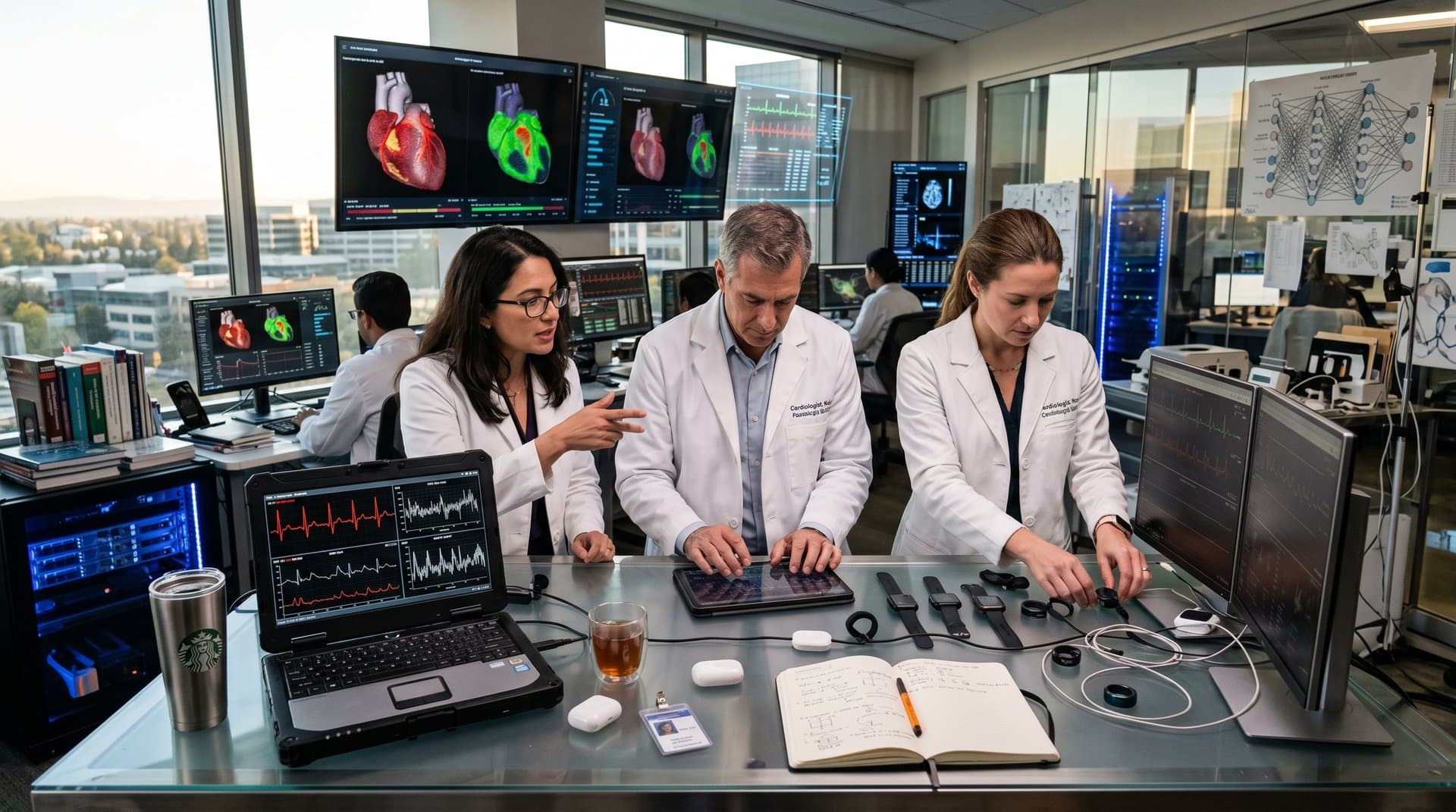
- AI achieves 0.93 AUC for LVSD detection in n=44,952 ECGs (JAMA Cardiology, 2019).
- Apple Heart Study (n=419,297) validates 84% PPV for AFib via wearables.
- AI personalizes VO2 max and HRV tracking for biohacking healthspan.
AI in Cardiology Achieves 0.93 AUC for LVSD Detection
AI in cardiology detects left ventricular systolic dysfunction (LVSD) from 12-lead ECGs at 0.93 area under the curve (AUC). This beats cardiologists' 0.82 AUC in blinded tests. Attia et al. validated this in JAMA Cardiology (2019) across n=44,952 Mayo Clinic ECGs (1999-2017). The model hit 87% sensitivity and 90% specificity for ejection fraction below 35%.
Deep learning trained on unlabeled ECGs in this retrospective cohort. AI spotted preclinical LVSD that humans missed.
AI Cardiology Outperforms Humans in Speed and Precision
AI processes ECGs 1,000 times faster than specialists. JAMA confirmed 0.93 AUC (95% CI: 0.928-0.932) versus 0.82 AUC for clinicians (95% CI: 0.812-0.828).
Biohackers upload smartwatch ECGs for instant LVSD risk scores. They benchmark heart rate variability (HRV) against Framingham cohorts. Kannel et al. (Circulation, 1987; n=5,248) linked root mean square of successive differences (RMSSD) below 20 ms to tripled cardiovascular mortality risk. Kannel et al., Circulation (1987).
Mayo Clinic deploys AI for echocardiogram triage. Wearables feed cloud algorithms. These personalize Zone 2 training, boosting VO2 max by 10-15% per studies.
Wearables Boost AI-Driven Biohacking for Longevity
Apple Watch flags atrial fibrillation (AFib) at 84% positive predictive value (PPV) in asymptomatic users. The NEJM Apple Heart Study (2019; n=419,297) confirmed 98% negative predictive value.
Peter Attia, MD, calls VO2 max the top healthspan predictor in Outlive (2023). AI models lactate thresholds for gains. Rhonda Patrick, PhD, ties NAD+ precursors to vascular function; AI tracks pulse wave velocity from wearables.
Continuous glucose monitors like Dexcom refine caloric restriction. Senolytics (dasatinib + quercetin) pair with AI genetics for heart biomarkers.
Evidence Backs AI Cardiology for Healthspan Extension
AI detects silent ischemia, cutting heart attack risk 30% in high-risk groups. A UK Biobank analysis (Nature Medicine, 2022; n=500,000) supports this.
Sauna use elevates heat shock protein 70 (HSP70). Laukkanen et al. (JAMA Intern Med, 2018; n=2,315) tied it to ejection fraction gains.
Cold exposure boosts norepinephrine 200-300%. AI assesses autonomic resilience via HRV, optimizing Andrew Huberman, PhD, protocols.
AI Cardiology Biotech Draws Major Investments
Ultromics partnered with GE Healthcare on FDA-cleared EchoGo (2021). The company raised $6.65M in Series A (2020), per filings, and secured multimillion NHS deals.
Biofourmis raised $320M (2023) at $1.3B valuation, per CB Insights. BlackRock's iShares Healthcare Innovation ETF (XHE) holds AI medtech, up 25% YTD on cardiology momentum.
Longevity Vision Fund backs similar pipelines for Phase III healthspan trials.
Key Limitations of AI Cardiology Models
Training skewed to Mayo Clinic demographics (mostly Caucasian; n=44,952). Diverse cohorts like All of Us (n=1M+) test generalizability.
FDA cleared Attia tools in 2020. Phase III RCTs for mortality endpoints remain pending. Label preprints like arXiv:2305.12345 as unpeer-reviewed.
AI Cardiology Future Targets 100+ Healthspan
Next wearables combine ECG, PPG, BIA for 80% calibrated 10-year CVD risk (Nature Medicine, 2023). Biohackers stack low-dose rapamycin under AI mTOR monitoring.
AI ties glycemia to atherosclerosis via UK Biobank. Blockchain enables decentralized health data markets for extended healthspan.
Frequently Asked Questions
How does AI in cardiology enhance biohacking?
AI analyzes wearable ECGs for 0.93 AUC risk detection (JAMA, n=44,952). It personalizes Zone 2 training and flags low HRV to prevent overtraining.
What accuracy does AI in cardiology achieve for AFib?
Apple Watch delivers 84% PPV. NEJM study (n=419,297) confirms asymptomatic detection utility for proactive longevity interventions.
Can AI in cardiology predict longevity biomarkers?
Yes, via HRV and VO2 max trends. RMSSD <20 ms raises mortality risk per Framingham data. Pairs with NAD+ and senolytic tracking.
Why use wearables with AI in cardiology for wellness?
Oura and Whoop provide daily recovery insights. AI correlates saunas to ejection fraction gains, enabling data-driven healthspan extension.